

Advanced Agility Ladder Drills for Elite Football Players
Share
Elite football is no longer won by straight-line speed alone. The game's fastest players combine explosive acceleration, rapid deceleration, exceptional footwork, elite body control and the ability to change direction in an instant—all while making split-second decisions under pressure. Agility ladder drills remain one of the most effective methods for developing movement quality, neuromuscular coordination and football-specific athleticism when used correctly. This guide explores how advanced ladder training develops speed, reaction time, movement efficiency and football performance, before progressing into elite-level drill variations, coaching cues and programming strategies used to prepare players for match-day demands.
Advanced Agility Ladder Drills for Elite Football Players
Modern football demands far more than raw pace. Whether pressing high, recovering defensively, escaping tight spaces or accelerating beyond an opponent, elite football players rely on exceptional movement efficiency every time they step onto the pitch.
While many players view the agility ladder as little more than a warm-up tool, coaches at professional academies understand its true value. When integrated into a structured football training programme, agility ladder drills improve coordination, proprioception, foot speed, balance and reactive movement patterns that transfer directly into match situations.
The difference lies not in the ladder itself—but in how it's used.
The best players don't simply move quickly. They move efficiently, remain balanced under pressure and produce explosive movement in every direction without wasting energy.
That combination of technical precision and athletic performance is exactly what separates elite footballers from average players.
Why Agility Ladder Training Still Matters at the Highest Level
Despite advances in sports science and football biomechanics, the agility ladder remains one of the simplest yet most versatile pieces of football training equipment available.
Used correctly, ladder sessions develop multiple athletic qualities simultaneously, including:
- Quick feet
- Dynamic balance
- Athletic coordination
- Movement control
- Neuromuscular training
- Motor coordination
- Reaction speed
- Sprint mechanics
- Football movement efficiency
- First-step quickness
- Explosive acceleration
- Positional agility
Unlike isolated gym exercises, football ladder drills teach the central nervous system to produce precise movement patterns repeatedly under increasing speed and cognitive demand.
Every accurate foot placement reinforces neural adaptation, helping players reduce unnecessary movement while improving rhythm, posture and overall athletic movement.
This creates better transfer into football-specific movement where fractions of a second often determine who reaches the ball first.
Football Is a Game of Controlled Chaos
Watch any elite match carefully and one pattern becomes obvious.
Players rarely sprint in perfectly straight lines.
Instead they constantly perform:
- Sharp lateral movement
- Rapid crossover steps
- Explosive change of direction
- Backward movement
- Forward sprint acceleration
- Defensive recovery runs
- Pressing transitions
- One-versus-one movement
- Attacking transitions
Every one of these actions demands exceptional body control and movement precision.
Traditional sprint training develops top-end speed, but football performance depends far more heavily upon acceleration mechanics, braking mechanics, eccentric deceleration and the ability to repeatedly produce force from awkward body positions.
Agility exercises bridge that gap by exposing players to multidirectional movement that closely resembles the physical demands of competitive football.
Developing Football Speed Starts with Better Movement Quality
Many players chase greater speed before improving the quality of their movement.
This approach often limits long-term athletic development.
Before increasing sprint volume or adding resistance bands, players should first master efficient movement mechanics.
Key qualities include:
- Stable athletic stance
- Fast ground contact time
- Reactive strength
- Proper running mechanics
- Effective force production
- Controlled deceleration
- Explosive acceleration
- Dynamic balance
Without these foundations, players often compensate with inefficient technique that reduces football explosiveness while increasing fatigue during repeated high intensity movement.
A well-designed agility ladder progression develops these qualities safely before progressing towards more advanced football speed training.
The Science Behind Elite Footwork
Elite footwork isn't simply about moving your feet faster.
It is the product of several systems working together simultaneously.
These include:
| Athletic Quality | Match-Day Benefit |
|---|---|
| Neuromuscular coordination | Faster movement execution |
| Proprioceptive training | Improved balance during directional changes |
| Motor learning | More efficient technical execution |
| Cognitive agility | Quicker decision making under pressure |
| Visual processing | Better reactions to opponents |
| Spatial awareness | Improved positioning |
| Athletic cognition | Faster anticipation of play |
| Movement precision | Cleaner first touches and sharper turns |
This is why elite football conditioning increasingly combines physical preparation with cognitive training.
Rather than rehearsing predictable patterns endlessly, advanced football coaching introduces reaction-based drills, visual cue training and anticipation drills that challenge both the body and the brain simultaneously.
Building the Foundation Before Advanced Ladder Drills
Many players rush towards complex footwork sequences before mastering fundamental movement patterns.
Doing so usually creates bad habits.
Instead, coaches should establish consistent technical standards first.
Every repetition should prioritise:
- Eyes forwards
- Relaxed shoulders
- Controlled arm drive
- Active foot placement
- Soft landings
- Stable hips
- Strong ankle stability
- Efficient posture
- Controlled breathing
These coaching cues improve movement quality while reducing unnecessary energy expenditure.
The objective isn't simply to complete the ladder—it is to move with complete control regardless of speed.
As execution improves, players naturally develop greater football athleticism without sacrificing balance or technical efficiency.
Choosing the Right Equipment
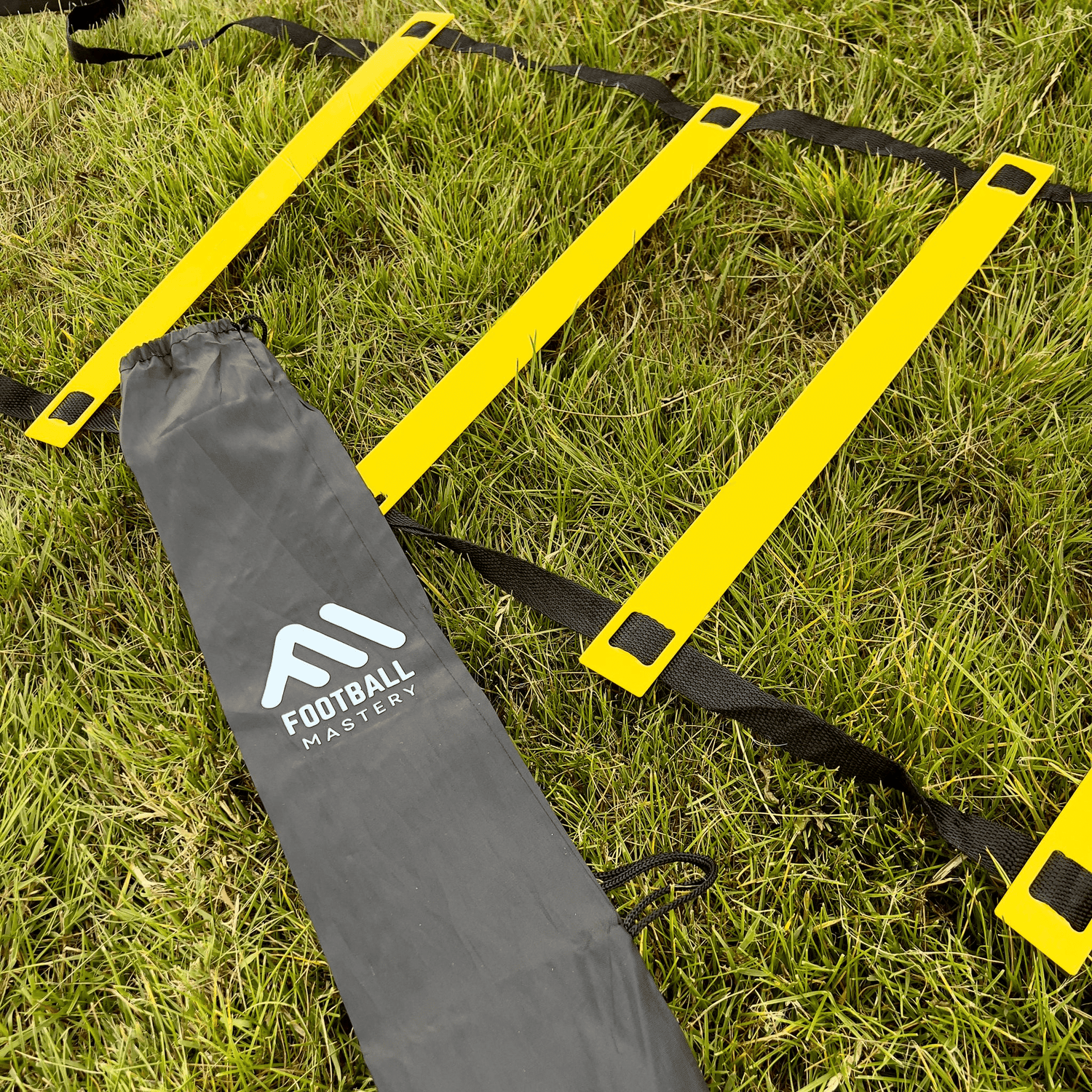
While technical execution always matters more than equipment, consistency becomes much easier with a durable, properly spaced agility ladder that stays flat throughout every drill.
A quality training ladder allows players to focus entirely on rhythm, coordination and precision instead of constantly adjusting displaced rungs between repetitions. This becomes increasingly important during advanced speed and agility sessions where high-tempo movement is essential.
Football Mastery's dedicated 3 Metre Agility Ladder has been designed specifically for football training, making it suitable for individual practice, academy sessions and team coaching where repeatable movement quality is the priority.
Advanced Agility Ladder Drills That Translate to Elite Match Performance
Once the fundamentals have been mastered, the focus shifts from simply moving through the ladder to developing football-specific movement that mirrors the unpredictable demands of competitive matches.
At this stage, every repetition should have a clear purpose. Rather than memorising increasingly complicated footwork patterns for their own sake, advanced ladder drills should improve explosive acceleration, reaction time, positional agility and the ability to produce repeated high-intensity movements under fatigue.
The objective is simple:
Train movement that wins football matches, not movement that only looks impressive during training.
Every drill should reinforce efficient mechanics while challenging the player's coordination, cognitive agility and technical consistency.
1. Ickey Shuffle with Explosive Exit
The Ickey Shuffle remains one of the most effective football ladder drills because it develops rhythm, foot speed and multidirectional movement while encouraging players to stay balanced throughout each repetition.
Coaching focus
- Maintain a low centre of gravity.
- Keep hips facing forwards.
- Strike the ground lightly.
- Use quick arm drive.
- Minimise ground contact time.
- Accelerate immediately after the final square.
After completing the ladder, explode into a 10–15 metre sprint.
This teaches players to transition instantly from controlled footwork into explosive movement, replicating situations such as breaking beyond a defender or reacting to a loose ball.
Progression
Introduce a coach's verbal or visual cue at the final square.
The player must react by sprinting:
- Left
- Right
- Straight ahead
- Backwards before accelerating forwards
Adding uncertainty develops reactive decision making alongside physical qualities.
2. Lateral In-and-Out with Directional Change
Elite footballers rarely move only forwards.
Full-backs defend wingers.
Midfielders scan in multiple directions.
Strikers constantly adjust their body position to receive passes under pressure.
This drill develops:
- Lateral movement
- Dynamic balance
- Football movement efficiency
- Close control footwork
- Athletic coordination
How to perform
- Begin side-on.
- Step both feet into each square.
- Exit laterally.
- Stay low throughout.
- Accelerate diagonally after leaving the ladder.
Focus on maintaining posture while avoiding excessive upper-body movement.
The cleaner the movement, the more efficiently force is transferred into acceleration.
3. Single-Leg Ladder Drills
Many football actions occur from one leg rather than two.
Landing after a header.
Cutting inside.
Striking the ball.
Changing direction.
Single-leg ladder drills improve proprioception, ankle stability and joint stability while exposing weaknesses between each side of the body.
Coaching objectives
- Maintain balance throughout.
- Control hip position.
- Avoid knees collapsing inwards.
- Land softly.
- Produce force through the forefoot.
This type of proprioceptive training contributes towards athletic resilience while reinforcing movement control during high-speed actions.
4. Carioca Drill for Rotational Mobility
Although often overlooked, the Carioca drill develops rotational control throughout the hips and trunk.
This improves football locomotion during:
- Recovery runs
- Defensive transitions
- Shielding the ball
- Turning under pressure
Good rotational mobility also supports football biomechanics by allowing smoother changes of direction without excessive stress on the knees.
Players should prioritise rhythm before increasing speed.
5. Scissor Steps into Forward Sprint
Few drills improve transition speed as effectively as this progression.
Complete rapid scissor steps through the ladder before exploding immediately into a forward sprint.
The emphasis should remain on:
- Explosive acceleration
- Sprint technique
- Running mechanics
- Force production
- Elastic energy
- Concentric power
Players should avoid standing upright too early during acceleration.
Instead, maintain a positive shin angle and drive forwards aggressively over the first five metres.
6. Hopscotch Drill with Reactive Cue
The Hopscotch drill develops reactive strength while improving movement precision and body control.
Instead of following a predetermined exit pattern, introduce a coloured cone or numbered marker beyond the ladder.
As the player reaches the final square, call a colour or number.
The player must immediately react and accelerate towards the correct target.
This combines:
- Visual processing
- Cognitive load training
- Reaction-based drills
- Anticipation
- Football intelligence
- Game awareness
These qualities become increasingly valuable during pressing situations where players must process changing information in fractions of a second.
Progressing Beyond Closed Skill Drills
Traditional ladder work is often described as a closed skill activity because movement follows a predictable pattern.
Football, however, is an open skill sport.
Opponents move.
Passing angles change.
Space disappears instantly.
To bridge that gap, advanced football coaching introduces uncertainty into every session.
Examples include:
- Random sprint directions.
- Unpredictable finishing zones.
- Ball reception after exiting the ladder.
- Defensive pressure immediately afterwards.
- Partner reaction drills.
- Passing combinations.
- Timed decision-making exercises.
The ladder becomes the starting point—not the entire drill.
This transition towards game-realistic agility produces far greater transfer into competitive performance.
Integrating Ladder Work with Other Speed Equipment
Although the agility ladder develops outstanding movement quality, elite football conditioning rarely relies on one piece of equipment alone.
Instead, coaches combine ladder work with:
- Cones for directional changes.
- Mini hurdles for plyometric progression.
- Resistance bands for acceleration mechanics.
- Markers for reaction drills.
- Sprint gates for performance measurement.
This layered approach challenges every component of athletic development, from neuromuscular efficiency to repeated sprint ability.
Players looking to build a complete home or club training environment should consider combining multiple pieces of dedicated football training equipment rather than relying on isolated drills. Football Mastery's collection of Football Coaching Equipment for Kids includes equipment suitable for developing coordination, speed and technical training in both individual and small-group sessions.
Common Mistakes That Limit Athletic Development
Even experienced players often reduce the effectiveness of agility ladder drills by rushing through repetitions without considering movement quality.
Watch for these common errors:
Looking down continuously
Players should develop confidence in their foot placement while keeping their vision forwards whenever possible.
Prioritising speed over technique
Fast but inefficient movement patterns reinforce poor habits.
Perfect execution should always come before maximum pace.
Heavy foot contacts
Elite athletes spend very little time on the ground.
Quick, controlled contacts improve reactive strength and acceleration.
Upright posture
Remaining tall throughout the drill limits force production and reduces explosive movement.
Stay in an athletic stance with slight forward lean.
Skipping recovery
High-quality speed and agility work depends upon freshness.
Allow adequate rest between repetitions so every effort is performed with maximum intent.
At this stage, players should be comfortable executing advanced ladder drills with precision, rhythm and consistency. However, the greatest improvements come from understanding when, how often and how these drills fit into a complete football performance programme.
Programming Agility Ladder Training for Maximum Football Performance
The most effective agility sessions aren't necessarily the longest.
Elite football players prioritise quality over quantity, ensuring every repetition is performed with maximum intent and technical precision. Fatigue quickly reduces movement quality, making poorly executed drills far less beneficial than shorter, focused sessions.
As a general guide:
| Training Goal | Frequency | Session Length |
|---|---|---|
| Technical footwork | 2–3 sessions per week | 10–15 minutes |
| Speed and agility development | 2 sessions per week | 15–25 minutes |
| Match preparation | 1–2 light sessions | 10–15 minutes |
| Off-season athletic development | 3 sessions per week | 20–30 minutes |
Each session should begin with a thorough dynamic warm up to prepare the muscles, joints and central nervous system for high-speed movement.
A quality warm-up should include:
- Mobility training
- Dynamic stretching
- Activation exercises
- Sprint preparation
- Movement screening
- Progressive acceleration drills
Preparing properly not only enhances performance but also contributes towards injury prevention by improving joint stability, hip mobility and movement readiness before explosive activity begins.
Position-Specific Ladder Drills
Although every footballer benefits from improved coordination and speed, different positions place unique physical demands on players.
Defenders
Defenders frequently perform:
- Defensive recovery speed
- Backward movement
- Lateral shuffle
- Explosive change of direction
- One-versus-one defending
Training should emphasise quick transitions between retreating and accelerating forwards while maintaining balance under pressure.
Midfielders
Midfielders require exceptional football movement efficiency throughout ninety minutes.
Sessions should focus on:
- Continuous directional changes
- Scanning while moving
- Reaction speed
- Cognitive agility
- Short explosive accelerations
- High work-rate movement patterns
Maintaining technical quality under fatigue is especially important for central midfielders covering large areas of the pitch.
Wingers
Wide players rely heavily upon:
- First-step quickness
- Explosive acceleration
- Close control footwork
- Football reactive speed
- Transition speed
Drills should finish with aggressive sprints that simulate attacking defenders in wide areas.
Strikers
Forwards often make decisive movements inside confined spaces.
Training priorities include:
- Sharp directional changes
- Explosive movement
- Reaction-based drills
- Anticipation
- Positional agility
The ability to create separation within one or two steps frequently determines goalscoring opportunities.
Combining Ladder Drills with Ball Work
While ladder drills build athletic qualities, football remains a game played with a ball.
Once movement patterns become automatic, integrate technical actions immediately after each repetition.
Examples include:
- First-touch passing
- Receiving on the half-turn
- Close control dribbling
- Short passing combinations
- One-touch finishing
- Crossing after acceleration
- Shooting under pressure
Adding football-specific actions encourages players to transfer improved movement mechanics directly into realistic match situations.
This integration also strengthens motor learning by connecting physical movement with technical execution and decision making.
Monitoring Progress
Elite development relies on measurable improvement rather than guesswork.
Players and coaches should regularly assess:
- Acceleration over 5 and 10 metres
- Sprint repeatability
- Ground contact time
- Technical consistency
- Reaction speed
- Movement precision
- Balance during directional changes
- Overall agility performance
Video analysis can also be extremely valuable.
Watching drills in slow motion often highlights subtle inefficiencies in posture, braking mechanics or foot placement that are difficult to identify in real time.
Small improvements in movement quality often produce significant gains in football performance over an entire season.
Recovery Is Part of Performance
High-intensity agility training places considerable demands on the nervous system.
Without adequate recovery, movement quality declines and the risk of overuse injuries increases.
Support recovery through:
- Quality sleep
- Good nutrition
- Hydration
- Active recovery sessions
- Mobility work
- Appropriate training progression
Building athletic resilience isn't simply about working harder—it's about allowing the body to adapt between sessions.
Consistent recovery supports neural adaptation, maintains movement efficiency and enables players to continue producing explosive performances throughout long competitive seasons.
Building a Complete Training Environment
Although the agility ladder forms the foundation of many speed sessions, the best long-term results come from combining complementary equipment and structured practice.
Whether you're training independently, coaching grassroots players or running academy sessions, having access to a variety of training tools allows you to progress exercises safely as movement quality improves.
For players looking to build a complete home training setup, Football Mastery offers a range of carefully selected Football Mastery Bundles that combine essential football training equipment for developing technical ability, coordination and athletic performance in one convenient package.
As players progress, combining structured equipment with consistent practice creates an environment where long-term improvement becomes sustainable rather than relying on isolated sessions.
Final Thoughts
Developing elite agility isn't about performing the most complicated ladder pattern or completing drills at the highest possible speed.
It is about building movement that transfers directly onto the football pitch.
Every sharp turn, explosive sprint, pressing transition and defensive recovery begins with efficient mechanics, exceptional coordination and the ability to produce force rapidly while maintaining complete control.
When programmed intelligently, agility ladder drills improve far more than quick feet. They enhance acceleration mechanics, dynamic balance, proprioception, football biomechanics, cognitive processing and overall athletic development, helping players move more efficiently in every phase of the game.
Whether you're an ambitious academy player, a grassroots footballer or an experienced coach striving to maximise player development, consistently refining movement quality will always provide a competitive advantage.
For more football training advice, performance resources and equipment designed to support players at every level, visit Football Mastery and continue building the physical qualities that separate good players from exceptional ones.
Frequently Asked Questions
1. Are agility ladder drills suitable for football players of all ages?
Yes. Agility ladder drills can be adapted for players of almost every age and ability. Younger players benefit from improved coordination, balance and motor skill development, while older and more advanced players can use more complex drills to improve reaction speed, explosive acceleration and football-specific movement. The key is selecting exercises that match the player's current level and gradually increasing the difficulty as technique improves.
2. Can agility ladder drills make you faster?
Agility ladder drills won't significantly increase your maximum sprint speed on their own, but they can improve foot speed, first-step quickness, acceleration, coordination and movement efficiency. When combined with sprint training, strength work and plyometrics, ladder drills can contribute to faster and more explosive football performance.
3. How long does it take to see improvements from agility ladder training?
Most players notice improvements in coordination, rhythm and footwork within two to four weeks of consistent practice. More significant improvements in acceleration, agility performance and football movement usually develop after six to twelve weeks when ladder drills are combined with strength training and football-specific speed work.
4. Should agility ladder drills be performed before or after football training?
For most players, agility ladder drills are best performed near the beginning of a training session after completing a dynamic warm-up. This allows players to perform each repetition with maximum quality while the nervous system is fresh. Performing high-speed footwork when fatigued often reduces movement quality and limits the benefits of the session.
5. What's the difference between agility and quickness in football?
Quickness generally refers to how rapidly a player can react and produce an initial movement, whereas agility is the ability to accelerate, decelerate and change direction efficiently while maintaining balance and control. Elite footballers require both qualities to perform consistently throughout a match.
6. Are agility ladder drills effective without a football?
Yes. Ladder drills can significantly improve athletic qualities such as coordination, balance, proprioception and foot speed without using a ball. However, once movement patterns have been mastered, adding football-specific skills such as passing, dribbling or shooting helps transfer those physical improvements into real match situations.
7. How many repetitions should each agility ladder drill include?
Rather than counting large numbers of repetitions, most coaches recommend completing each drill for three to six high-quality efforts with full concentration. Rest periods of 30 to 90 seconds between repetitions help maintain speed, technique and movement quality throughout the session.
8. Can agility ladder drills improve football endurance?
Indirectly, yes. Although ladder drills are not designed as endurance training, they improve movement efficiency, allowing players to move more economically during matches. This can reduce unnecessary energy expenditure and help maintain performance during repeated high-intensity actions over ninety minutes.
9. What surface is best for agility ladder training?
A flat, non-slip surface such as natural grass, artificial turf or an indoor sports hall provides the safest environment for agility ladder drills. Uneven or slippery surfaces increase the risk of poor foot placement and reduce the effectiveness of high-speed movement training.
10. What are the biggest mistakes players make during agility ladder drills?
The most common mistakes include looking down throughout the drill, sacrificing technique for speed, taking heavy foot contacts, using poor posture, failing to use the arms correctly and progressing to advanced drills before mastering the fundamentals. Consistent technical execution will always produce better long-term results than simply moving through the ladder as quickly as possible.