

Best Agility Ladders for Football Training UK Coaches Guide
Share
Whether you coach grassroots football, academy-level players, or youth development squads, agility ladders remain one of the most effective tools for improving foot speed, coordination, balance, and explosive movement. This guide explores how football agility ladders improve technical footwork, acceleration, reaction time, and movement efficiency while helping coaches build more dynamic training sessions. You’ll also discover how to choose the right football training ladder UK coaches rely on, common mistakes to avoid, and the best agility ladder drills for footballers across different age groups and positions.
Football has evolved into a game of explosive acceleration, sharp changes of direction, and rapid decision-making. Modern players are expected to combine technical skill with athletic performance, which is why agility training for football has become a core part of coaching sessions across every level of the game.
From youth football agility training to elite football development drills, coaches throughout the UK now rely on agility ladders to sharpen foot speed, reaction time, coordination, and multidirectional movement patterns.
But not all football agility equipment is created equal.
A poor-quality ladder can disrupt movement mechanics, reduce session quality, and even increase injury risk. Choosing the right football footwork ladder means understanding how different ladder designs influence movement efficiency, balance, proprioception, and neuromuscular activation.
In this guide, we’ll break down everything coaches need to know about selecting the best agility ladders for football training, including:
- What agility ladders actually improve
- The best ladder drills for footballers
- How coaches use agility ladders in SAQ football coaching
- Key features to look for before buying
- Common training mistakes
- The best setups for youth and academy football
What Are Agility Ladders Used For in Football?
A football agility ladder is one of the simplest yet most versatile pieces of football coaching equipment available today.
At first glance, it may appear to be nothing more than a flat ladder placed on the ground. In reality, however, it becomes a framework for developing:
- Fast feet drills
- Coordination and rhythm training
- Acceleration and deceleration mechanics
- Dynamic footwork
- Body control
- Lateral movement
- Sprint transition drills
- Visual reaction training
- Match-specific agility
The biggest misconception among coaches is that agility ladders only improve speed.
They don’t.
Agility ladder football training primarily develops movement efficiency and neuromuscular coordination. Players learn how to position their feet quickly and accurately while maintaining balance and spatial awareness under pressure.
This becomes especially important in modern football, where tight spaces and rapid transitions demand elite athlete footwork and cognitive agility football skills.
Why Football Coaches Use Speed and Agility Ladders
The best coaches integrate speed and agility ladder work into multiple areas of training:
| Training Goal | Benefit |
|---|---|
| Warm-up drills | Activates muscles and improves mobility |
| SAQ drills | Develops speed, agility, and quickness |
| Technical footwork | Improves coordination and touch |
| Injury prevention football | Enhances stability and movement mechanics |
| Football conditioning | Builds reactive movement capacity |
| Pre-match activation | Increases sharpness and reaction speed |
For grassroots football coaching, ladders also offer exceptional versatility. A single portable agility ladder can support dozens of drills for players of different ages and abilities.
This makes them ideal for:
- Junior football drills
- Academy football drills
- Female football agility training
- Goalkeeper ladder drills
- Home agility ladder training football sessions
- Indoor football agility drills
Benefits of Agility Ladder Training for Footballers
The best agility ladder UK coaches use isn’t necessarily the most expensive model — it’s the one that allows players to move naturally, quickly, and efficiently.
When used correctly, football ladder drills can significantly improve overall sports performance.
1. Improved Foot Speed
Quick feet training is fundamental in football.
Players constantly adjust their body positioning while scanning the pitch, reacting to opponents, and accelerating into space. Agility ladder exercises teach players to reduce ground contact time while improving coordination between the brain and lower body.
This directly supports:
- First-step quickness
- Explosive movement
- Faster transitions
- Better acceleration mechanics
For attacking players, this can create sharper movement in tight spaces. For defenders, it improves recovery speed and lateral reactions.
2. Better Change of Direction
Football is rarely linear.
Players must decelerate, pivot, shuffle, and accelerate repeatedly throughout a match. Ladder work improves change of direction mechanics by reinforcing efficient foot placement and balance.
This is especially valuable for:
- Wingers
- Midfielders
- Full-backs
- Pressing systems
- Small-sided games
Advanced agility ladder drills can also include cones, hurdles, and reaction drills to replicate game-speed training environments.
For coaches building complete football training circuits, combining ladders with resistance bands and shuttle runs creates highly effective SAQ equipment setups.
You can explore versatile training setups within the Football Mastery Bundles collection, which combines multiple tools for speed agility quickness training.
3. Enhanced Coordination and Balance
Balance and coordination often separate technically gifted players from physically dominant ones.
Ladder training develops:
- Motor skills
- Proprioception
- Coordination training
- Spatial awareness
- Movement patterns
- Body control
These adaptations help footballers maintain composure during rapid directional changes and physical contact.
This is particularly important in youth football development, where players are still refining movement mechanics and athletic development foundations.
Coaches working with younger age groups frequently combine agility ladder drills for beginners with reaction-based games to improve engagement and learning retention.
For youth sessions, dedicated kids football coaching equipment can help create more enjoyable and structured technical practices.
4. Supports Reactive Agility and Decision-Making
Modern football requires more than physical speed.
Players must process visual information quickly and react under pressure. This is where reactive agility training becomes essential.
By integrating cognitive reaction drills into agility ladder sessions, coaches can train:
- Football scanning drills
- Decision-making drills
- Reaction speed football drills
- Match-specific agility
- Cognitive processing speed
For example:
A coach may call colours, numbers, or directional cues mid-drill, forcing players to adjust movement patterns instantly.
This style of reactive training is widely used within elite football training environments because it closely mirrors in-game demands.
How Agility Ladders Improve Football Performance
Many coaches ask:
“Are agility ladders good for football?”
The answer depends entirely on how they are used.
Agility ladders alone won’t magically improve sprint speed or transform athletic performance overnight. However, when integrated into structured football coaching drills, they become incredibly effective for improving movement quality.
The key areas improved include:
Neuromuscular Activation
Ladder drills stimulate the nervous system and prepare players for explosive activity.
This is why many football fitness coaches include agility ladder warm-up routines before:
- Sprint training
- Plyometrics
- Technical sessions
- Matchday preparation
Movement Efficiency
Efficient players waste less energy.
Ladder work reinforces cleaner sprint mechanics and more economical movement patterns, helping footballers maintain intensity throughout matches.
This becomes particularly valuable during:
- High pressing phases
- Counter-attacks
- Recovery runs
- Transitional play
Injury Reduction
While ladders are not a standalone injury prevention system, they can support:
- Ankle stiffness training
- Coordination and rhythm training
- Joint stability
- Deceleration mechanics
- Player mobility training
When paired with proper strength work and football conditioning, they contribute to safer athletic movement.
How to Choose the Best Agility Ladder UK Coaches Recommend
Choosing the right football training ladder UK coaches trust depends on several factors.
Not every ladder is suitable for every environment.
A coach working indoors with youth players may prioritise portability and safety, while academy football coaches may focus on durability and advanced drill flexibility.
Key Features to Look For
Adjustable Rungs
An adjustable agility ladder allows coaches to customise spacing depending on:
- Player age
- Drill complexity
- Sprint mechanics
- Footwork objectives
Wider spacing often suits explosive acceleration drills, while tighter spacing supports coordination ladder drills and fast feet drills.
Durable Construction
Cheap ladders often twist, snap, or slide during intense sessions.
A premium agility ladder should feature:
- Strong nylon straps
- Anti-slip design
- Durable plastic rungs
- Weather resistance
- Stable ground grip
This becomes crucial for year-round outdoor football coaching in UK conditions.
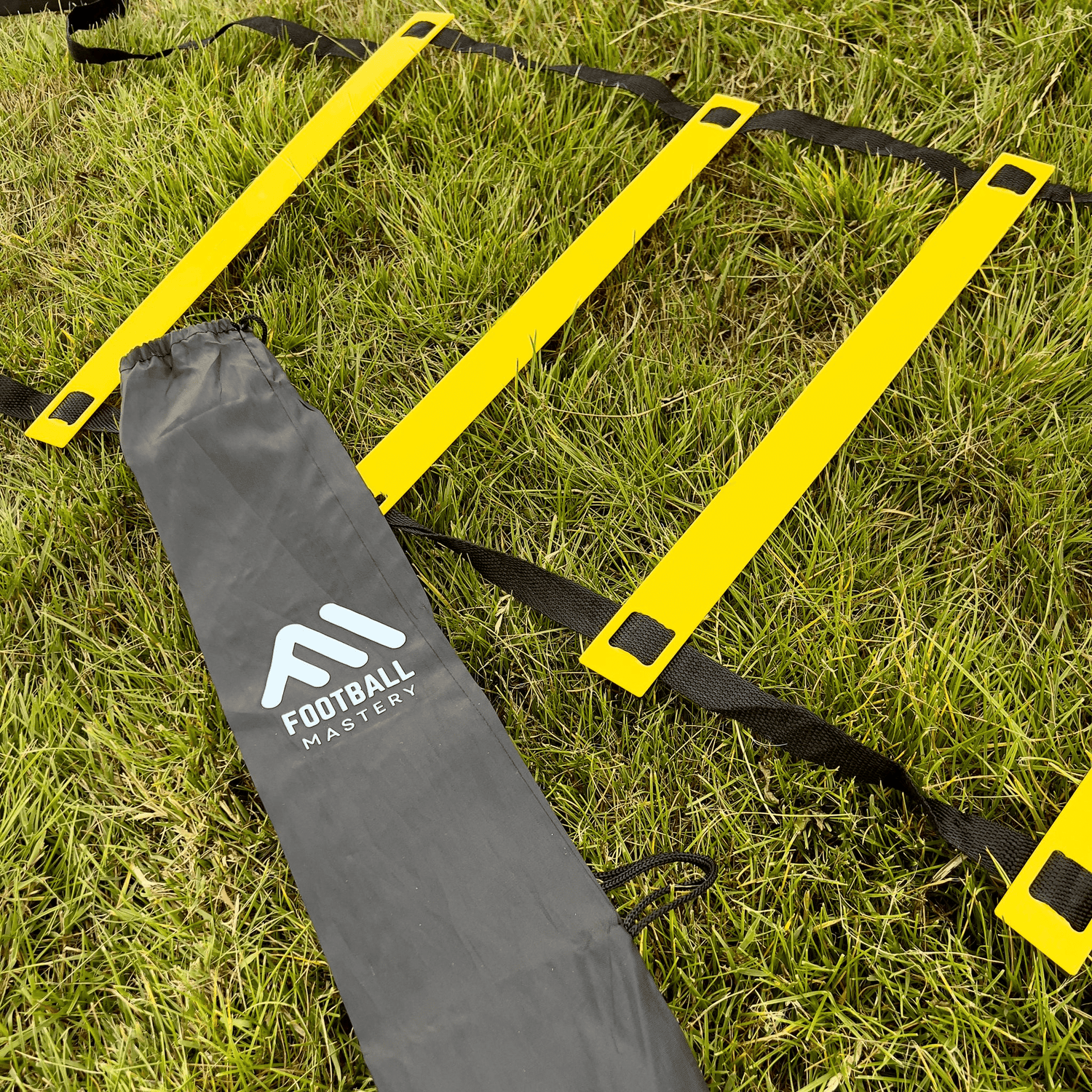
One popular option among coaches is the 3M Agility Ladder, designed for football speed training, technical footwork, and SAQ ladder drills across all age groups.
Best Ladder Drills for Footballers
The most effective football ladder drills are the ones that replicate realistic movement demands found during matches.
Too many coaches rely on repetitive patterns that improve rhythm but fail to develop reactive agility, acceleration mechanics, or decision-making speed.
The best agility ladder drills for footballers should train:
- Foot speed
- Balance and coordination
- Acceleration and deceleration
- Dynamic footwork
- Change of direction
- Cognitive reaction
- Match-specific agility
Below are some of the most effective drills used in football coaching sessions across grassroots, academy, and elite football training environments.
1. One-In-One-Out Drill
This foundational movement is ideal for agility ladder drills for beginners.
How It Works
- One foot enters each square
- One foot exits outside the ladder
- Repeat rhythmically down the ladder
Benefits
- Coordination ladder drills
- Fast feet drills
- Rhythm development
- Neuromuscular activation
- Technical footwork
This drill is particularly effective during warm-up ladder drills and pre-match activation routines.
2. Lateral Quick Shuffle
Football is a multidirectional sport, making lateral movement training essential.
Coaching Focus
- Stay low
- Maintain balance
- Avoid crossing feet
- Keep hips square
Benefits
- Defensive footwork
- Recovery movement
- Side-to-side acceleration
- Body control
- Football movement efficiency
This drill is especially valuable for defenders and midfielders who frequently adjust positioning during transitions.
3. Ickey Shuffle
One of the most widely used agility ladder football training drills in modern SAQ football coaching.
Movement Pattern
- Step in
- Step out
- Two feet inside
- Repeat continuously
Why Coaches Use It
The Ickey Shuffle improves:
- Reactive movement
- Coordination and rhythm training
- Foot speed
- Cognitive processing
- Sprint transition drills
It also translates effectively into pressing systems and high-intensity football conditioning sessions.
4. In-Out Sprint Combination
This combines football ladder drills for speed with acceleration mechanics.
Structure
- Complete fast-feet pattern through ladder
- Explode into 5–10 metre sprint
- Decelerate under control
Benefits
- First-step quickness
- Explosive movement
- Football acceleration drills
- Game-speed training
- Sprint mechanics
Adding cones or reaction calls can transform this into reactive agility training.
5. Reactive Colour Call Drill
This is where ladder training becomes truly football-specific.
Example Setup
- Coach assigns colours to cone directions
- Player completes ladder sequence
- Coach shouts colour
- Player reacts instantly
Trains
- Decision-making drills
- Visual reaction training
- Football scanning drills
- Reaction speed football drills
- Cognitive agility football
This style of drill is commonly used in academy football drills and elite football development programmes.
SAQ Training for Football
SAQ stands for:
- Speed
- Agility
- Quickness
It has become one of the most important components of football athletic development.
Agility ladders are central to SAQ training football systems because they allow coaches to blend technical movement patterns with explosive athletic actions.
What Makes SAQ Training Effective?
Traditional conditioning often focuses purely on endurance.
SAQ drills develop:
- Rapid acceleration
- Deceleration mechanics
- Directional change
- Coordination
- Neuromuscular efficiency
- Reactive movement
In football, these qualities matter far more than straight-line speed alone.
Building an Effective SAQ Football Coaching Session
A structured SAQ session may include:
| Training Phase | Example |
|---|---|
| Activation | Agility ladder warm-up routine |
| Footwork | Quick feet training |
| Acceleration | Sprint transition drills |
| Agility | Cone reaction work |
| Conditioning | Shuttle runs |
| Power | Plyometric ladder drills |
The best coaches combine ladders with:
- Cones
- Hurdles
- Resistance bands
- Sprint training
- Plyometrics
This creates more complete football fitness drills that develop athletic performance in realistic movement patterns.
Agility Ladder Drills by Position
Different football positions demand different movement qualities.
The best football coaching drills reflect those positional differences.
Agility Ladder Drills for Strikers
Strikers rely heavily on:
- First-step acceleration
- Sharp directional changes
- Explosive movement
- Quick reactions
Recommended drills include:
- Ickey shuffle to sprint
- Split-step acceleration
- Reactive cone exit drills
- Sprint and finish combinations
These drills improve movement separation inside the penalty area.
Football Footwork Exercises for Midfielders
Midfielders require:
- Constant scanning
- Coordination under fatigue
- Tight-space movement
- High work-rate conditioning
Effective drills include:
- Lateral shuffle variations
- Reactive agility patterns
- Multi-directional ladder circuits
- Ball-control ladder combinations
Midfield players benefit greatly from football movement training that combines technical work with agility performance development.
Football Agility Workouts for Defenders
Defenders must master:
- Recovery movement
- Lateral speed
- Deceleration control
- Body positioning
Recommended drills:
- Backpedal ladder work
- Side shuffle exits
- Mirror reaction drills
- Deceleration mechanics training
Adding reaction speed football drills creates more realistic defensive scenarios.
Goalkeeper Ladder Drills
Goalkeepers require unique footwork qualities:
- Fast repositioning
- Explosive lateral movement
- Balance under pressure
- Reactive acceleration
Useful goalkeeper-specific drills include:
- Lateral in-out patterns
- Split-step ladder movements
- Quick reset footwork
- Dive transition drills
Combining ladders with hurdles can significantly improve goalkeeper coordination and reaction mechanics.
Common Football Footwork Mistakes Coaches Should Avoid
Even the best agility ladder UK coaches recommend can become ineffective if sessions are poorly structured.
Here are some of the most common errors.
Overemphasising Speed Over Technique
Many players rush through ladders without maintaining posture or control.
Poor mechanics reduce the effectiveness of:
- Coordination training
- Sprint mechanics
- Movement efficiency
- Balance and coordination
Quality movement should always come before speed.
Using Generic Drills Repeatedly
Repeating the same patterns every week limits athletic development.
Players need exposure to:
- Reactive agility
- Cognitive reaction drills
- Directional changes
- Match-specific agility
- Football biomechanics
Variation is essential.
Ignoring Football Context
Some coaches treat ladder work like generic fitness training.
Football agility sessions should include:
- Decision-making
- Visual scanning
- Ball integration
- Positional movement
- Reaction cues
This creates more transferable movement skills.
Excessive Ladder Volume
Too much ladder work can lead to fatigue without meaningful adaptation.
Agility ladders should support football training — not replace it.
Most effective sessions use ladders for:
- Warm-ups
- Activation
- Technical movement prep
- Short SAQ blocks
Quality always outweighs quantity.
How Coaches Use Agility Ladders in Football Training Circuits
One of the biggest advantages of a portable agility ladder is versatility.
Coaches can quickly build football training circuits that target multiple physical qualities simultaneously.
Example Football Agility Circuit
Station 1 — Ladder Footwork
Fast-feet coordination drill
Station 2 — Hurdles
Plyometric jumps for explosive power
Station 3 — Shuttle Runs
Acceleration and deceleration work
Station 4 — Cone Reactions
Reactive agility training
Station 5 — Sprint Finish
Football acceleration drills
This style of football conditioning improves:
- Speed endurance football
- Anaerobic football conditioning
- Athletic performance
- Match readiness
- Movement efficiency
For coaches wanting flexible setups, the Football Mastery homepage includes a range of football fitness equipment suitable for SAQ equipment circuits and technical training environments.
Why Agility Ladders Remain Essential in Modern Football Coaching
Despite advances in sports science and football biomechanics, agility ladders continue to play a major role in player development because they remain:
- Affordable
- Portable
- Versatile
- Easy to integrate
- Effective for all ages
From grassroots football coaching to elite football academies, ladders help players refine the small movement details that often separate good players from great ones.
When paired with structured coaching and progressive football development drills, they become one of the most valuable tools in modern football training.
Youth Football Agility Training Tips
Coaching younger players requires a completely different approach compared to senior or academy-level football.
Children develop movement patterns rapidly, which makes agility ladder drills for youth football extremely valuable when introduced correctly. However, younger age groups should prioritise coordination, rhythm, balance, and enjoyment rather than pure speed.
The best coaches understand that youth football agility training is about building athletic foundations first.
Focus on Movement Quality Over Intensity
Many grassroots coaches rush players through drills too quickly.
At younger ages, players should learn:
- Proper foot placement
- Balance and coordination
- Controlled acceleration
- Body awareness
- Rhythm and timing
Simple coordination ladder drills often produce better long-term athletic development than highly advanced patterns.
A quality youth session should include:
- Dynamic footwork
- Fun reaction games
- Light sprint mechanics
- Ball integration
- Cognitive challenges
This creates stronger movement foundations while improving engagement levels.
Keep Drills Short and Varied
Children lose concentration quickly during repetitive sessions.
The most effective football coaching sessions for younger age groups usually involve:
- Short drill durations
- Frequent rotation
- Competitive elements
- Visual reaction training
- Football-specific movement
For example:
Instead of running the same ladder drill repeatedly, coaches can combine ladders with cones, shuttle runs, and ball work to maintain intensity and enjoyment.
This also improves:
- Decision-making speed
- Coordination training
- Movement efficiency
- Football scanning drills
- Reactive agility
Use Age-Appropriate Ladder Spacing
One of the most overlooked factors in football agility training is rung spacing.
Incorrect spacing can disrupt sprint mechanics and movement quality.
General Guidelines
| Age Group | Recommended Focus |
|---|---|
| Under 7s | Rhythm and coordination |
| Under 10s | Balance and quick feet |
| Under 13s | Direction changes and acceleration |
| Under 16s | SAQ drills and reactive agility |
| Academy/Senior | Match-speed movement integration |
An adjustable agility ladder allows coaches to adapt drills based on player development stages.
Football Preseason Agility Programme Structure
Preseason is one of the best times to introduce structured football agility training.
Players return after periods of reduced activity, making neuromuscular activation and movement retraining particularly important.
The best football preseason agility programme gradually progresses from basic coordination toward advanced football movement training.
Week 1–2: Movement Foundations
Focus Areas:
- Balance and coordination
- Technical footwork
- Mobility exercises
- Light acceleration work
- Agility ladder warm-up routine
Recommended drills:
- One-in-one-out patterns
- Lateral quick shuffle
- Basic SAQ ladder drills
- Controlled shuttle runs
At this stage, coaches should prioritise movement quality and injury prevention football principles.
Week 3–4: Speed and Direction Changes
Players can now increase intensity.
Focus Areas:
- Explosive movement
- Acceleration and deceleration
- Quickness drills football
- Sprint transition drills
- Reactive agility training
Recommended additions:
- Cone reaction exits
- Ladder-to-sprint combinations
- Plyometric ladder drills
- Multidirectional speed work
This phase helps players prepare for competitive match demands.
Week 5+: Match-Specific Agility
Once players regain conditioning levels, sessions should become more football-specific.
Focus Areas:
- Match-speed training
- Decision-making drills
- Cognitive agility football
- Reactive movement
- Position-specific footwork
The best football coaching drills now combine:
- Ball work
- Opposed movement
- Transition play
- Visual scanning
- Football biomechanics
This ensures agility work transfers directly into performance.
Indoor Football Agility Drills vs Outdoor Sessions
UK coaches often need flexibility due to weather conditions.
Fortunately, agility ladders adapt well to both indoor and outdoor environments.
Indoor Football Agility Drills
Indoor sessions are ideal for:
- Technical footwork
- Quick feet training
- Neuromuscular activation
- Warm-up drills
- Rehabilitation work
Because space is limited, coaches often focus more heavily on:
- Fast feet drills
- Coordination patterns
- Reactive movement
- Body control
- Movement efficiency
Indoor work is particularly effective for return-to-play agility drills after injury.
Outdoor Football Agility Sessions
Outdoor sessions allow coaches to integrate:
- Sprint mechanics
- Long acceleration work
- High-speed directional changes
- Football conditioning
- Large-scale SAQ equipment circuits
Combining ladders with sprint training and shuttle runs creates more game-realistic conditioning demands.
Outdoor sessions also provide opportunities for:
- Position-specific drills
- Small-sided transition games
- Match-speed movement training
- Football agility testing
Choosing the Right Football Agility Equipment Setup
The best football coaching environments rarely rely on a single training tool.
Agility ladders work best when combined with complementary football practice equipment.
Essential SAQ Equipment for Football Coaches
Most advanced coaches use combinations of:
- Cones
- Hurdles
- Resistance bands
- Speed poles
- Reaction lights
- Sprint markers
- Plyometric equipment
These tools improve:
- Explosive agility drills
- Speed endurance football
- Coordination and rhythm training
- Acceleration mechanics
- Reactive agility
For coaches building full training setups, combining ladders with additional football fitness equipment creates far more varied and engaging sessions.
Are Agility Ladders Good for Football?
This remains one of the most searched questions among coaches and parents.
The short answer:
Yes — when used correctly.
Agility ladders improve several key qualities required in football:
- Foot speed
- Coordination
- Balance
- Change of direction
- Reaction speed
- Neuromuscular efficiency
- Technical footwork
However, ladders should support football development rather than dominate training sessions.
The most effective coaches integrate ladder work within broader football coaching drills that also include:
- Ball mastery
- Sprinting
- Tactical awareness
- Positional movement
- Conditioning
Final Thoughts
The best agility ladders for football training are the ones that help players move better, react faster, and train more effectively within realistic football environments.
Whether you coach grassroots teams, academy players, or elite footballers, agility ladders remain one of the most versatile and valuable pieces of football coaching equipment available today.
When integrated properly into football coaching sessions, ladders can help improve:
- Foot speed
- Reactive agility
- Coordination
- Acceleration
- Technical movement
- Athletic performance
- Match readiness
Most importantly, they provide coaches with a simple but highly adaptable tool that supports player development at every age and ability level.
From warm-up drills to advanced SAQ football coaching systems, agility ladders continue to play a vital role in modern football training across the UK.
FAQ Section — Best Agility Ladders for Football Training UK Coaches Guide
What material is best for a football agility ladder?
The best football agility ladders are typically made from durable plastic rungs combined with heavy-duty nylon straps. Coaches should look for anti-slip agility ladder designs that remain stable during high-intensity football coaching drills and outdoor UK training conditions.
Premium materials also improve longevity when used regularly in football conditioning and SAQ training football sessions.
Can agility ladders help improve football stamina?
Agility ladders primarily improve foot speed, coordination, and movement efficiency, but they can also contribute to speed endurance football when integrated into high-intensity circuits.
Combining agility ladder exercises with shuttle runs, sprint training, and reactive agility drills creates more demanding cardiovascular football conditioning sessions.
Are agility ladders suitable for professional football training?
Yes. Professional football agility ladder systems are widely used in academy football drills and elite football training programmes.
Top-level coaches use ladders for:
- Neuromuscular activation
- Pre-match preparation
- Technical footwork
- Movement efficiency
- Reactive agility training
The drills themselves are usually more advanced and integrated with cognitive reaction drills and football biomechanics work.
What is the ideal ladder spacing for football drills?
The best ladder spacing for football drills depends on the player’s age, stride length, and training objective.
- Narrow spacing supports quick feet training and coordination ladder drills
- Wider spacing suits acceleration mechanics and explosive agility drills
Adjustable agility ladders are ideal because coaches can adapt sessions for different age groups and football development drills.
Should footballers use agility ladders with a ball?
Yes — especially during advanced football coaching sessions.
Once players develop good movement mechanics, adding a football increases realism and improves:
- Technical footwork
- Ball control under pressure
- Coordination
- Scanning ability
- Match-specific agility
Combining ball mastery with football ladder drills creates more game-relevant movement patterns.
Are agility ladders effective for rehabilitation training?
Agility ladders are commonly used during return-to-play agility drills because they help players rebuild:
- Balance
- Coordination
- Foot stability
- Controlled movement patterns
- Deceleration mechanics
However, rehabilitation sessions should always progress gradually and follow guidance from qualified medical or sports science professionals.
How long should football agility ladder sessions last?
Most agility ladder football training blocks only need to last between 10 and 20 minutes.
The goal is quality movement rather than excessive fatigue.
Longer sessions can reduce technical sharpness and negatively affect:
- Sprint mechanics
- Foot speed
- Coordination
- Reaction time
Short, intense SAQ ladder drills are usually most effective.
Can goalkeepers benefit from agility ladder training?
Absolutely.
Goalkeeper ladder drills improve:
- Lateral movement
- Fast repositioning
- Reaction speed
- Dynamic footwork
- Explosive movement
Many football fitness coaches use ladders alongside diving drills and reaction training to improve overall goalkeeper athletic performance.
What surfaces are best for agility ladder training?
Football agility ladders can be used on:
- Grass pitches
- Artificial turf
- Indoor sports halls
- Gym flooring
- Rubber training surfaces
However, coaches should avoid slippery or uneven ground that could disrupt movement mechanics or increase injury risk during football acceleration drills.
Are agility ladders worth buying for grassroots football coaches?
Yes. Few pieces of football practice equipment offer as much versatility at such a low cost.
A single speed ladder for football can support:
- Warm-up drills
- Junior football drills
- SAQ training
- Technical footwork
- Reactive agility training
- Football conditioning circuits
For grassroots football coaching, agility ladders remain one of the most cost-effective tools available.