

Essential Speed and Agility Training Equipment for Football Players
Share
Speed and agility are no longer optional attributes in modern football. Whether you're a grassroots player developing athletic movement skills or a competitive footballer striving to improve acceleration and reaction time, the right training tools can dramatically improve performance. Equipment such as agility ladders, training cones, agility poles, speed hurdles and resistance trainers help players develop quicker footwork, sharper changes of direction, improved sprint mechanics and better movement efficiency. This guide explores the most effective football speed training equipment, explains how each piece contributes to athletic development, and highlights how to build a complete training setup that translates directly to match-day performance.
Essential Speed and Agility Training Equipment for Football Players
Football has evolved into a game where fractions of a second can decide the outcome of a match. The ability to accelerate rapidly, change direction under pressure and react instantly to developing situations often separates good players from great ones.
While technical ability remains vital, modern coaches place increasing emphasis on speed development, agility development and football conditioning equipment that enhances athletic performance training. The most effective players combine technical excellence with explosive movement, balance, coordination and quick decision-making.
The foundation of this development lies in selecting the right speed and agility training equipment.
Elite footballers are rarely just fast runners. They are efficient movers who can accelerate, decelerate, react and reaccelerate repeatedly throughout a match.
To build these qualities effectively, players need equipment designed specifically for football movement training rather than generic fitness exercises.
Why Speed and Agility Matter in Football
Football demands constant changes in movement patterns. During a single match, players may:
- Sprint into space
- React to loose balls
- Press opponents
- Recover defensively
- Change direction multiple times
- Accelerate from standing starts
- Perform explosive movement drills
This combination of actions requires more than straight-line speed.
Players must develop:
- Acceleration training capabilities
- Reactive agility
- Coordination training
- Balance and coordination training
- Multi-directional movement
- Deceleration training
- Reacceleration training
- Football movement efficiency
The right football agility training equipment helps coaches recreate these match scenarios repeatedly in training environments.
The Agility Ladder: The Foundation of Fast Footwork
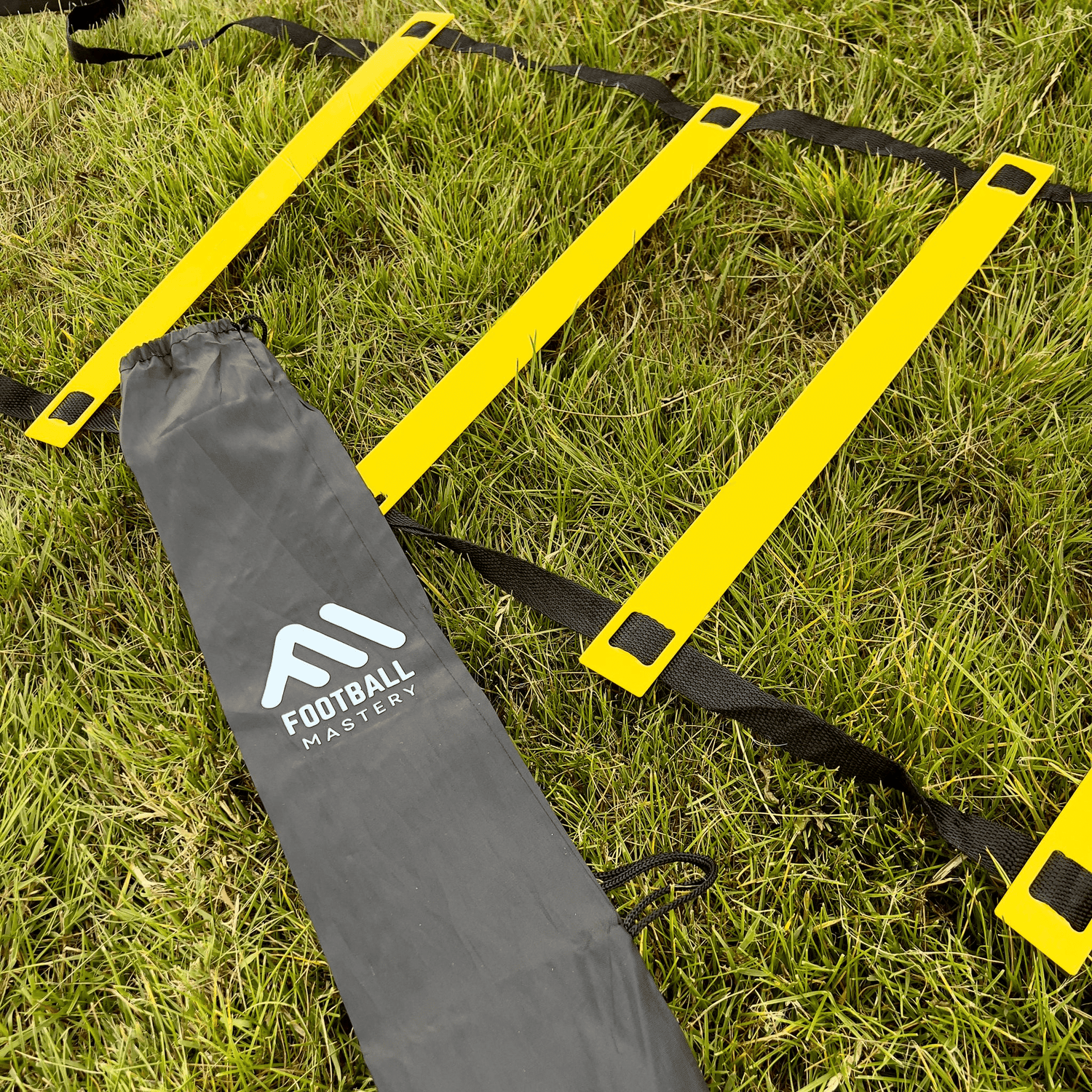
Among all forms of footwork training equipment, few tools are as versatile as the agility ladder.
The agility ladder remains one of the most popular pieces of football coaching equipment because it develops the foundation of quick, controlled movement. Through structured agility ladder drills and speed ladder drills, players can significantly improve foot speed training and movement mechanics.
A quality ladder allows players to perform:
- One-foot runs
- Two-foot runs
- Lateral movement drills
- In-and-out patterns
- Crossover movements
- Reactive agility training sequences
For players looking to develop quicker feet and sharper coordination, the 3M Agility Ladder provides an effective training solution suitable for all ages and ability levels.
Benefits of Agility Ladder Training
| Performance Area | Benefit |
|---|---|
| Footwork | Improves quick feet drills |
| Coordination | Enhances body control |
| Agility | Supports rapid direction changes |
| Movement Efficiency | Encourages economical movement |
| Balance | Develops stability under pressure |
When combined with football fitness drills, agility ladders become one of the most cost-effective tools for long-term athletic development.
Training Cones: The Most Versatile Football Training Equipment
If agility ladders teach movement patterns, training cones teach players how to apply them.
Training cones are arguably the most versatile piece of football training equipment available. Coaches use them for everything from warm-ups and positional drills to advanced acceleration drills and reaction drills.
Different types include:
- Marker cones
- Disc cones
- Flat markers
- Training markers
Their simplicity makes them essential for creating structured football conditioning drills and speed and agility drills.
How Cones Improve Football Performance
Cone-based exercises help players:
- Improve change of direction speed
- Increase sprint speed
- Develop balance
- Improve reaction time
- Enhance coordination
- Build explosive power
Common cone drills include:
- Shuttle runs
- Zig-zag sprints
- Box drills
- Reactive movement exercises
- Sprint technique drills
- Change of direction drills
These exercises are particularly effective for youth speed and agility training because they can be adapted to virtually any age group.
For younger players beginning their football development journey, specialised equipment from the Kids Football Coaching Equipment collection can help create engaging and effective training sessions.
Agility Poles and Slalom Poles: Developing Match-Ready Movement
While ladders and cones focus heavily on footwork and coordination, agility poles introduce realistic movement patterns that closely resemble situations encountered during matches.
Known variously as:
- Agility poles
- Slalom poles
- Slalom training poles
- Speed poles
- Football training poles
these tools are widely used by academies and professional clubs.
Unlike cone drills, slalom drills require players to navigate around upright obstacles while maintaining speed and control.
This develops:
- Football acceleration training
- Lateral movement training
- Multidirectional speed training
- Athletic movement skills
- Football quickness training
- Match-speed training
The biggest advantage of slalom training is that it encourages players to move dynamically rather than mechanically, helping bridge the gap between training-ground exercises and real-game scenarios.
Agility Hurdles and Speed Hurdles: Building Explosive Athleticism
Once players have developed sound movement patterns through ladders, cones and slalom poles, the next step is increasing power and explosiveness.
This is where agility hurdles and speed hurdles become invaluable.
Designed to challenge coordination, timing and lower-body power, hurdles force players to generate force rapidly while maintaining balance and body control. They are a staple component of professional-level football conditioning equipment and sports agility equipment programmes.
What Hurdle Training Improves
Regular hurdle sessions can help players:
- Improve acceleration
- Build explosive power
- Increase quickness
- Develop balance
- Improve first-step speed
- Enhance athletic performance
- Improve sprint mechanics
- Strengthen movement mechanics
Unlike traditional running drills, hurdle exercises require players to produce force vertically and horizontally, which better reflects the demands of football.
Popular hurdle-based exercises include:
- Single-leg hurdle hops
- Lateral hurdle jumps
- Sprint-to-hurdle combinations
- Reactive hurdle drills
- Acceleration hurdle sequences
These drills challenge both physical and neurological systems, supporting neuromuscular training and functional speed training simultaneously.
The quickest footballers are not always the strongest athletes. They are often the players who can produce force efficiently and repeatedly throughout a match.
Resistance Training Equipment for Football Speed Development
Speed is not simply about moving your legs faster. It is about producing more force into the ground.
This is why resistance-based football speed training equipment has become increasingly popular at every level of the game.
Some of the most effective tools include:
- Resistance bands
- Resistance parachutes
- Speed parachutes
- Sprint resistance trainers
These pieces of equipment create controlled resistance that forces players to work harder during acceleration phases.
Benefits of Resistance Training
Resistance work can help:
- Increase sprint speed
- Improve acceleration
- Enhance sprint mechanics
- Build explosive power
- Improve force production
- Develop speed endurance training capacity
- Improve change of pace training
Many coaches use resistance equipment during dedicated football acceleration training sessions because it encourages proper body positioning and driving mechanics.
A typical progression might include:
- Resisted sprint
- Unresisted sprint
- Reactive sprint drill
- Football-specific movement pattern
This approach develops both linear speed training and football-specific athletic performance.
Agility Rings and Training Hoops
While often overlooked, agility rings and training hoops offer tremendous value for football athletic development.
Unlike ladders, which guide movement in straight lines, rings encourage more dynamic and unpredictable movement patterns.
Players can use:
- Speed rings
- Agility rings
- Training hoops
to perform:
- Fast footwork drills
- Coordination drills
- Reaction drills
- Lateral movement sequences
- Multidirectional speed training exercises
These drills challenge a player's ability to maintain balance while moving rapidly through different planes of motion.
Why Coaches Use Agility Rings
Agility ring exercises are particularly effective because they:
- Enhance coordination
- Improve movement efficiency
- Develop balance
- Improve footwork
- Increase quickness
- Support cognitive agility training
Many coaches integrate ring work into warm-ups because it combines dynamic warm-up equipment with meaningful athletic development.
Reaction Training Equipment: Developing Faster Decision Making
Physical speed is only part of football performance.
The best players can process information quickly and react instantly.
This is where reaction training equipment becomes essential.
Football is increasingly recognising the importance of:
- Cognitive agility training
- Reactive agility training
- Reaction speed training
- Football movement training
Several tools can help develop these attributes:
- Reaction balls
- Coaching sticks
- Training markers
- Coloured cones
- Rebounders
By introducing unpredictable stimuli into drills, coaches can force players to think and react rather than simply perform rehearsed movements.
For example, a player may:
- Sprint towards a cone
- Receive a visual signal
- Change direction
- React to a pass
- Finish on goal
This combination of physical and cognitive demands closely mirrors real match situations.
Rebounders and Ball Control Trainers
Football-specific speed development should never be separated entirely from technical development.
While sprint training equipment is crucial, players also need opportunities to combine movement with ball mastery.
This is where rebounders and ball control trainers become highly effective additions to any training setup.
Benefits include:
- Improving first touch
- Enhancing reaction time
- Developing passing accuracy
- Improving ball control under pressure
- Supporting football performance training
A well-designed drill might combine:
- Agility ladder work
- Cone sprint
- Rebounder pass
- Directional change
- Shooting action
This creates a complete football-specific athletic performance drill that develops both technical and physical qualities simultaneously.
For players and coaches looking to create a complete training environment, the Football Mastery Bundles offer multiple training tools that can be combined into comprehensive development sessions.
Portable Goals and Target Goals for Speed-Based Finishing Drills
Speed training becomes significantly more effective when players have a clear objective.
Portable football goals and target goals allow coaches to connect movement exercises with realistic football outcomes.
Rather than sprinting for the sake of sprinting, players perform:
- Acceleration drills
- Sprint drills
- Change of direction drills
- Reaction drills
before immediately applying those movements in finishing situations.
This approach helps bridge the gap between athletic development and match performance.
Research consistently shows that players learn and retain movement patterns more effectively when they are connected to football-specific actions.
As a result, portable goals have become an important component of modern football fitness equipment and football conditioning equipment programmes.
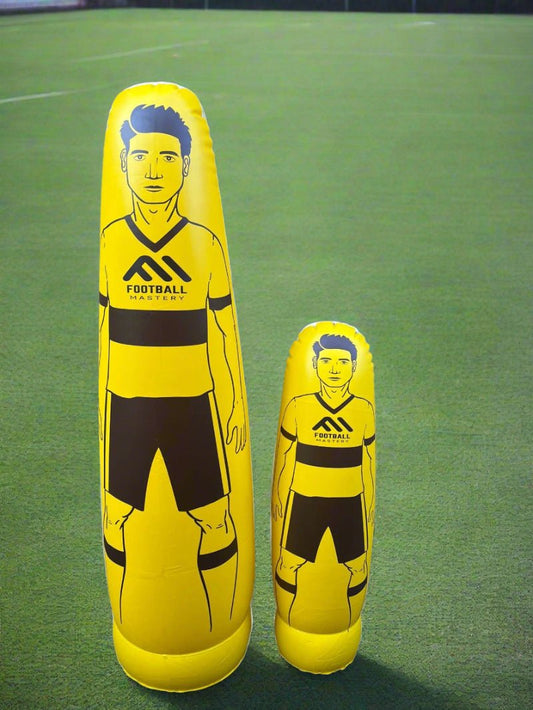
Training Dummies and Free-Kick Mannequins
Speed and agility are often associated with running mechanics, but football-specific movement frequently involves navigating around opponents.
Training dummies and free-kick mannequins allow coaches to recreate realistic scenarios where players must make rapid decisions while maintaining control of their movement.
These tools are excellent for:
- Reactive agility training
- Football movement training
- Change of direction training
- Decision-making drills
- Match-speed training
- Athletic performance drills
For attackers, mannequins can simulate defenders during dribbling exercises. For midfielders, they create passing lanes that encourage scanning and movement. For defenders, they help develop positioning and recovery speed.
When combined with cones, poles and footballs, mannequins transform simple drills into game-realistic exercises that develop both technical and physical attributes simultaneously.
Building the Ultimate Speed and Agility Set
One of the most common mistakes coaches and players make is relying too heavily on a single training tool.
An agility ladder alone won't maximise performance.
Similarly, cones without reactive elements may improve movement patterns but fail to prepare players for the demands of competitive football.
The most effective speed and agility set combines multiple forms of football speed training equipment to target different performance qualities.
A balanced setup should include:
Core Equipment
- Agility ladder
- Training cones
- Agility poles
- Speed hurdles
Advanced Equipment
- Resistance parachute
- Agility rings
- Reaction ball
- Rebounder
Football-Specific Equipment
- Footballs
- Portable football goals
- Target goals
- Training bibs
This combination creates a comprehensive system for football conditioning drills and long-term athletic development.
Sample Speed and Agility Training Session
To illustrate how these tools work together, here's a simple football-specific session.
Dynamic Warm-Up
- Light jogging
- Mobility exercises
- Ladder footwork patterns
Speed Development Phase
- 10m acceleration drills
- Resisted sprint training
- Sprint technique drills
Agility Phase
- Cone drills
- Slalom drills
- Agility ring sequences
- Change of direction drills
Reactive Phase
- Reaction ball exercises
- Coach-led directional commands
- Reactive agility drills
Football Application
- Passing combinations
- Rebounder work
- Finishing exercises using target goals
Conditioning Finish
- Football fitness drills
- High-intensity shuttle runs
- Football conditioning drills
This structure develops:
- Speed and quickness training
- Football acceleration training
- Athletic movement skills
- Movement efficiency
- Technical execution under fatigue
Choosing Equipment Based on Age and Ability
Not every player requires the same equipment.
The most effective training programmes are built around a player's current stage of development.
Youth Players
Young footballers benefit most from:
- Agility ladders
- Marker cones
- Flat markers
- Mini hurdles
- Training hoops
The focus should be on:
- Coordination training
- Balance and coordination training
- Athletic movement skills
- Football athletic development
Intermediate Players
As players mature, training can incorporate:
- Agility poles
- Speed hurdles
- Resistance bands
- Reaction training equipment
The emphasis shifts towards:
- Speed development
- Agility development
- Reactive agility
- Running technique training
Advanced Players
Competitive players should utilise:
- Resistance parachutes
- Sprint resistance trainers
- Rebounders
- Training dummies
- Advanced reaction systems
These tools support:
- Elite football conditioning
- Multidirectional speed training
- Football quickness training
- Speed endurance training
- Match-speed training
The key is progression. Equipment should challenge players without overwhelming them, ensuring continual improvement throughout their football journey.
Common Mistakes When Training Speed and Agility
Even with the best equipment available, poor training habits can limit results.
Avoid these common errors:
Focusing Only on Straight-Line Speed
Football rarely involves uninterrupted sprinting. Players must also train:
- Lateral movement training
- Deceleration training
- Reacceleration training
- Change of pace training
Ignoring Reaction-Based Drills
Purely pre-planned exercises have value, but football is unpredictable.
Including reaction drills and cognitive agility training helps players transfer athletic improvements directly into matches.
Neglecting Technique
Poor movement mechanics reduce efficiency and increase injury risk.
Players should prioritise:
- Sprint mechanics
- Running technique training
- Functional speed training
- Movement efficiency
Using Too Much Equipment at Once
More equipment does not automatically create better sessions.
Focus on purposeful drill design and progressive overload rather than complexity for its own sake.
Final Thoughts
The modern game demands more than technical ability alone. Players who can accelerate faster, react quicker and change direction more efficiently gain a significant advantage in every area of the pitch.
The most effective approach combines multiple forms of football agility equipment and football speed training equipment, including agility ladders, training cones, agility poles, speed hurdles, resistance trainers and reaction-based tools.
By incorporating these tools into structured training sessions, players can improve acceleration, increase sprint speed, enhance coordination, develop balance, build explosive power and ultimately improve match fitness.
Whether you're a coach designing sessions for a grassroots team or a player striving to reach the next level, investing in the right equipment can dramatically improve long-term football performance.
For a complete range of football training solutions designed to support speed, agility and overall player development, explore the full collection at Football Mastery.
Frequently Asked Questions About Speed and Agility Training Equipment for Football Players
1. How often should football players train speed and agility each week?
For most players, 2–3 dedicated speed and agility sessions per week is ideal. This provides enough stimulus for speed development and agility development without negatively affecting recovery or football training. Younger players may benefit from shorter, more frequent sessions, while advanced players can handle higher training loads.
2. What is the best speed and agility training equipment for beginners?
Beginners should start with simple, versatile equipment such as:
- Agility ladders
- Training cones
- Marker cones
- Flat markers
- Mini hurdles
These tools help establish proper movement mechanics, coordination and footwork before progressing to more advanced football speed training equipment.
3. Can speed and agility equipment be used at home?
Yes. Many forms of football agility training equipment require very little space and can be used in gardens, driveways, parks or local pitches. Agility ladders, cones, speed rings and resistance bands are particularly effective for home-based football performance training.
4. At what age should players begin speed and agility training?
Players can begin age-appropriate speed and agility training from as young as six or seven years old. The focus should be on fun, engaging activities that develop coordination, balance and athletic movement skills rather than intensive conditioning or resistance work.
5. Is expensive equipment necessary to improve football speed?
No. Some of the most effective football coaching equipment is also among the most affordable. Agility ladders, training cones and agility poles can deliver excellent results when used consistently within a structured training programme.
6. What is the difference between speed training and agility training?
Speed training primarily focuses on straight-line acceleration and sprinting ability, while agility training develops a player's ability to change direction efficiently while maintaining balance and control.
Football requires both qualities because players rarely run in a straight line for extended periods during matches.
7. How long does it take to see improvements in speed and agility?
Most players notice improvements in coordination, footwork and movement efficiency within a few weeks of consistent training. Significant gains in acceleration, agility and sprint performance typically occur after 6–12 weeks of structured speed and quickness training.
8. Should footballers train speed and agility with or without a ball?
Both approaches are important.
Training without a ball allows players to focus on movement quality, sprint mechanics and athletic development. Training with a ball helps transfer those physical improvements into football-specific situations.
The most effective programmes combine both methods.
9. Can speed and agility training help reduce injuries?
Yes. Properly designed speed and agility drills can improve balance, coordination, body control and movement efficiency. This may help reduce the risk of common football injuries by teaching players to accelerate, decelerate and change direction more effectively.
10. Which piece of equipment provides the best overall value for football players?
If only one piece of equipment can be purchased, an agility ladder is often considered the best value. It supports:
- Footwork training
- Coordination training
- Quick feet drills
- Speed ladder drills
- Dynamic warm-ups
- Agility development
When paired with a set of training cones, players can perform hundreds of different football fitness drills and speed and agility exercises suitable for every age and ability level.