

Football Agility Ladder Drills for Beginners and Youth Players
Share
Young footballers do not become quicker, sharper, and more balanced simply by running laps around a pitch. Real improvement comes from controlled movement, coordination, and repetition. Agility ladder drills are one of the most effective ways to build fast footwork, reaction time, acceleration, and confidence on the ball — especially for beginners and youth players still developing movement mechanics.
In this guide, you’ll learn how simple ladder workouts can improve athletic performance, why they matter for youth football development, and which beginner agility drills create the biggest difference during matches. We’ll also explore easy routines that can be practised at home, in schools, or during junior football training sessions using minimal agility equipment.
Why Agility Training Matters in Modern Football
Football has evolved into a game of rapid transitions, explosive movement, and constant multidirectional movement. Players rarely sprint in straight lines for long distances. Instead, they shuffle, pivot, accelerate, decelerate, and react within seconds.
For younger players especially, agility training helps build the foundations required for long-term athletic development.
Benefits include:
- Faster reaction time
- Improved balance and coordination
- Better lower body coordination
- Increased movement efficiency
- Sharper change of direction
- Improved body control
- Enhanced neuromuscular training
- Stronger acceleration training habits
- Better confidence during one-v-one situations
Many coaches now include speed ladder drills in youth football drills because they develop fast footwork without placing excessive stress on growing joints.
If you're building a complete home training setup, using proper kids football coaching equipment can help young players practise safely and consistently.
What Is an Agility Ladder?
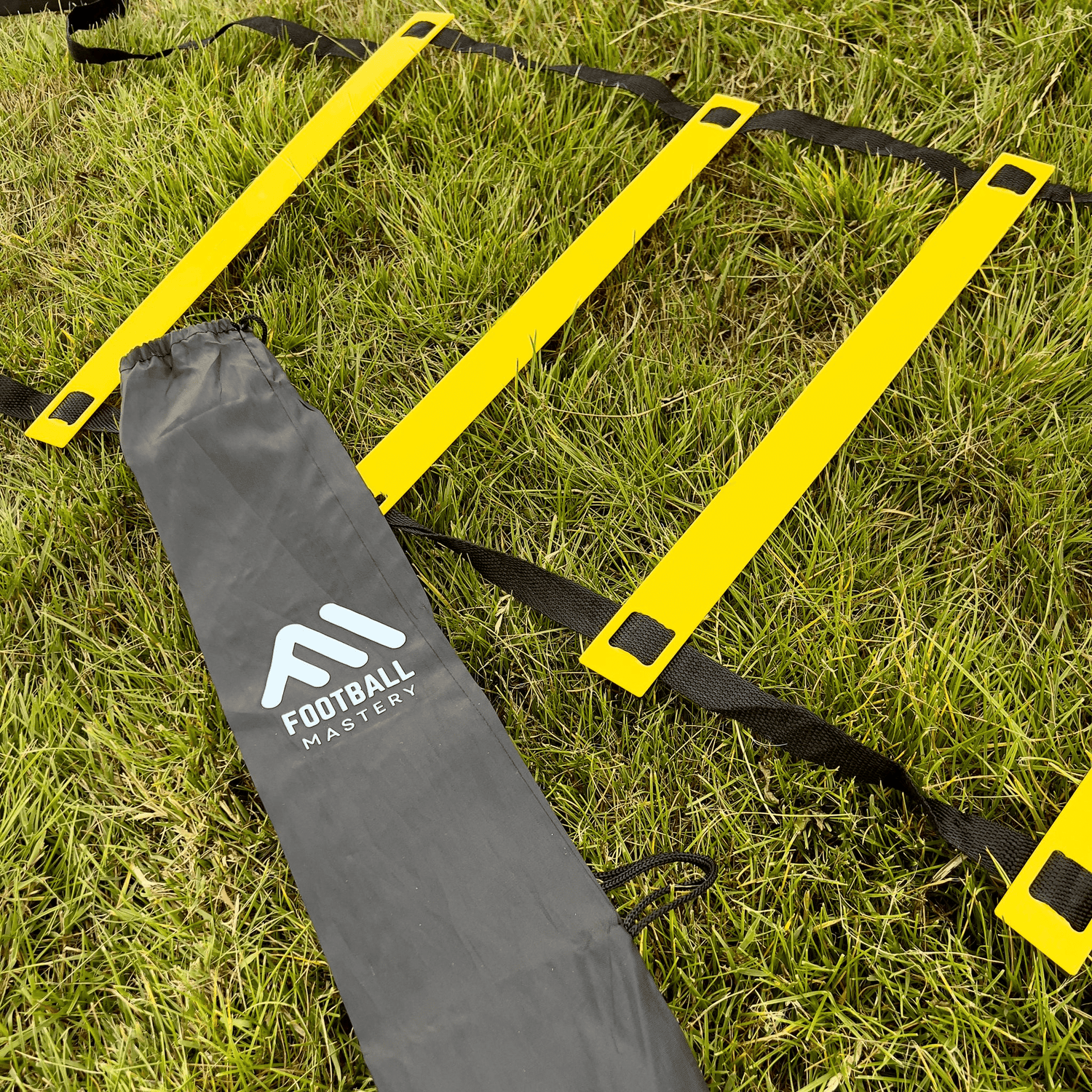
An agility ladder is a lightweight piece of training equipment laid flat on the ground to create evenly spaced squares for footwork drills.
Players move through the ladder using different movement patterns designed to improve:
- Foot speed
- Lateral movement
- Coordination drills
- Athletic footwork
- Explosive speed
- Dynamic movement
Unlike traditional running drills, ladder exercises force players to think while moving. This develops proprioception and cognitive agility alongside physical speed.
The best youth football agility ladder workout routines challenge both the brain and the body simultaneously.
The Importance of Footwork for Young Players
Before a young footballer learns advanced tactics, they must first learn how to move efficiently.
Poor movement mechanics can affect:
- Sprinting speed
- First touch
- Dribbling control
- Defensive positioning
- Shooting balance
- Injury prevention
Simple ladder drills teach players how to stay light on their feet while maintaining rhythm and posture.
This becomes especially valuable during:
- Defensive recovery runs
- Tight-space dribbling
- Quick passing combinations
- Pressing situations
- Counter attacks
Fast feet drills also help players remain balanced while changing direction at speed.
How Often Should Beginners Use Agility Ladder Drills?
For beginners and younger age groups, consistency matters more than intensity.
A good starting point is:
| Age Group | Recommended Sessions |
|---|---|
| 6–8 years | 2 short sessions weekly |
| 9–12 years | 3 sessions weekly |
| 13–16 years | 3–4 sessions weekly |
Sessions should usually last:
- 10–20 minutes
- Focus on quality over speed
- Prioritise coordination first
- Increase training intensity gradually
Overloading young athletes with excessive plyometric ladder drills too early can negatively affect movement quality.
Essential Beginner Ladder Drills
Below are some of the best ladder drills for soccer players who are just beginning agility training.
1. One Foot in Each Box
This is the foundation of almost every agility ladder for beginners routine.
How to perform it:
- Start at one end of the ladder
- Step one foot into each square
- Maintain a steady rhythm
- Pump your arms naturally
- Stay on the balls of your feet
Focus areas:
- Coordination
- Movement patterns
- Body control
- Rhythm
This beginner ladder exercise develops confidence and introduces proper foot placement.
2. Two Feet in Each Box
Once players feel comfortable with basic movement, progression becomes important.
Benefits:
- Improves fast-twitch muscle training
- Develops cardiovascular conditioning
- Builds speed and agility training habits
- Enhances lower body coordination
Players should remain relaxed while increasing tempo gradually.
Avoid leaning backwards, as this reduces movement efficiency.
3. The In-and-Out Drill
The in-and-out drill is excellent for developing lateral quickness and balance.
Steps:
- Begin with feet outside the ladder
- Step both feet inside the square
- Step both feet back outside
- Repeat through the ladder
This movement improves:
- Side-to-side mobility
- Football conditioning
- Reaction speed
- Athletic performance
It is also one of the most effective football agility drills for speed and balance.
Why Youth Players Benefit From Ladder Work
Agility ladder drills for 8-12 year olds are particularly effective because younger athletes absorb movement habits rapidly.
At this stage of development, training should prioritise:
- Coordination exercises for kids
- Fun agility drills
- Reactive agility football drills
- Balance and rhythm
- Technical movement over power
The goal is not simply to move faster.
The goal is to move smarter.
This is why many academy coaches combine ladder drills with:
- cone and ladder drills
- football movement training
- ladder drills with football
- soccer quickness drills
Using varied movement patterns helps prevent training boredom while improving sports performance.
Building Confidence Through Simple Ladder Drills
One overlooked benefit of football footwork for beginners is confidence building.
Young players who improve their movement often become:
- More willing to dribble
- Faster to close opponents down
- Better at receiving passes
- More composed under pressure
This confidence frequently transfers directly into match performance.
Parents creating home football training drills should focus on encouragement rather than perfection.
Even small improvements in:
- acceleration
- balance
- coordination
- reaction time
can dramatically improve field performance over time.
Creating a Beginner Soccer Footwork Routine at Home
One reason agility ladder drills at home have become so popular is their simplicity.
A basic home setup requires:
- An agility ladder
- Flat ground
- 15 minutes
- Consistency
Back gardens, parks, playgrounds, and school halls all work well.
For families wanting complete starter setups, football training bundles from Football Mastery Bundles can help simplify home sessions for young players.
Common Mistakes Beginners Make
Even easy agility drills can become ineffective if technique is ignored.
Common issues include:
Looking Down Constantly
Players should glance down occasionally, but keeping the head up improves game-speed movement habits.
Rushing Too Early
Quick feet drills only work when movement remains controlled.
Heavy Foot Contact
Players should stay light and reactive.
Poor Arm Movement
Arms are essential for balance and acceleration.
Overtraining
Youth athletic development requires recovery alongside practice.
The Link Between Agility and Ball Control
Many people think ladder workouts only improve running speed.
In reality, they also help:
- dribbling rhythm
- first touch balance
- close control
- defensive positioning
- passing movement
This happens because agility work strengthens neuromuscular connections used during technical football actions.
As players become more coordinated, they often notice improved control during:
- tight turns
- quick passing sequences
- attacking transitions
- defensive recovery
The second part of this article will cover advanced beginner drills including the Icky Shuffle, carioca drill variations, lateral shuffle progressions, and how to combine football speed drills with ball mastery exercises.
Advanced Football Agility Ladder Drills for Beginners and Youth Players
Once young players become comfortable with the fundamentals, the next step is introducing more advanced movement patterns that improve reaction speed, explosive acceleration, and on-field agility.
The key is progression.
Players should first master rhythm and coordination before increasing intensity. When ladder exercises become too repetitive, introducing new footwork drills keeps training engaging while continuing athletic development.
The Icky Shuffle Drill
The Icky Shuffle is one of the most recognised football ladder drills because it develops coordination, lateral movement, and directional control simultaneously.
Although the name sounds playful, this drill is highly effective for:
- attacking players
- midfielders
- defensive footwork
- rapid directional changes
How to Perform the Icky Shuffle
- Step one foot inside the first square
- Bring the second foot inside
- Step the lead foot outside the ladder
- Repeat moving forward
The movement should feel fluid rather than rushed.
Key Coaching Points
- Keep hips low
- Stay light on the toes
- Maintain arm movement
- Focus on rhythm before speed
This exercise is excellent for soccer speed and reaction drills because players must constantly reposition their body while moving forward.
Young footballers who improve rhythm and body control often appear “quicker” even before they gain physical speed.
The Carioca Drill
The carioca drill introduces rotational movement patterns rarely developed through straight-line sprinting.
This exercise improves:
- hip mobility
- rotational coordination
- multidirectional movement
- balance under pressure
It is especially useful for defenders and midfielders who regularly adjust body position while tracking opponents.
Drill Instructions
Players move sideways through the ladder while crossing one leg in front of and behind the other.
Benefits of the Carioca Drill
- Develops movement mechanics
- Enhances mobility and agility
- Improves coordination under fatigue
- Builds fluid movement transitions
This drill can initially feel awkward for younger players, but repetition improves movement confidence rapidly.
Lateral Shuffle Progressions
Football is filled with side-to-side movement.
Players constantly:
- jockey opponents
- shift defensively
- close passing lanes
- react to feints
The lateral shuffle drill helps players stay balanced while moving sideways at speed.
Basic Side Shuffle Drill
Instructions:
- Face forwards
- Shuffle sideways through the ladder
- Place both feet inside each square
- Keep shoulders level
This movement develops:
- quick feet
- defensive movement
- lower body coordination
- reaction time
The side shuffle drill is one of the best football coordination drills for kids because it combines simplicity with real match relevance.
High Knees Ladder Drill
The high knees ladder drill focuses heavily on acceleration mechanics and explosive movement.
Main Benefits
- Improves sprint mechanics
- Enhances muscle activation
- Develops cardiovascular conditioning
- Builds explosive speed
Players should drive knees upward while maintaining controlled foot placement.
Avoid:
- leaning backwards
- slamming feet heavily
- sacrificing posture for speed
This drill works particularly well as a pre-match agility warm-up.
Hopscotch Drill Variations
The hopscotch drill develops:
- balance
- single-leg strength
- proprioception
- coordination under instability
It is one of the most effective beginner agility drills for developing athletic balance in younger players.
Basic Pattern
- Jump with feet apart outside the ladder
- Land with feet together inside each square
- Repeat rhythmically
More advanced progressions include:
- single-leg hops
- diagonal footwork
- reactive commands
- football passing combinations
Combining Ladder Drills With Ball Work
One of the biggest mistakes in youth football training is separating athletic training entirely from football actions.
Eventually, players should combine:
- ladder drills with football
- first touch exercises
- dribbling sequences
- reaction-based passing
This creates more realistic football movement training.
Example Combination Drill
Sequence:
- Complete speed ladder exercise
- Sprint to cone
- Receive pass
- Dribble through markers
- Finish with shot or pass
This type of session develops:
- cognitive agility drills
- technical control under fatigue
- game-speed movement
- decision-making
Players learn how to stay composed after intense footwork sequences.
Cone and Ladder Drills for Match Realism
Cone and ladder drills are particularly effective because they mimic directional changes seen during matches.
A simple setup may include:
- agility ladder
- cones
- football
- sprint zone
Example Routine
| Phase | Action |
|---|---|
| 1 | In-and-out ladder drill |
| 2 | Sprint to cone |
| 3 | Backpedal to start |
| 4 | Receive football |
| 5 | Dribble through cones |
This develops:
- acceleration
- deceleration
- ball control
- reaction speed
- movement efficiency
Football Agility Drills for Speed and Balance
Speed without control is rarely useful in football.
The best players combine:
- explosive acceleration
- balance
- composure
- body control
This is why youth soccer agility drills should always include controlled movement patterns alongside sprint work.
Some highly effective football foot speed drills include:
- crossover ladder drill
- shuffle and sprint
- sprint ladder exercises
- backpedal drills
- reactive ladder races
These exercises improve both physical quickness and football-specific coordination.
How Schools and Grassroots Coaches Use Ladder Training
Agility ladder drills for PE classes are becoming increasingly common because they are:
- affordable
- simple to organise
- scalable for groups
- adaptable for all ages
Schools often use ladder workouts to improve:
- athletic development
- coordination
- cardiovascular fitness
- confidence in sport participation
For grassroots coaches, ladder sessions are useful because they require minimal setup while keeping players active continuously.
Training Intensity for Youth Players
A common misconception is that harder training automatically creates better players.
For younger athletes, quality matters more than exhaustion.
Good youth soccer speed and agility routines should:
- prioritise technique
- allow recovery
- maintain enjoyment
- gradually increase complexity
Overly intense football conditioning can negatively affect:
- movement quality
- motivation
- injury prevention
- technical learning
The best youth development programmes focus on long-term movement quality rather than short-term fatigue.
Building a Weekly Agility Routine
Here is a simple weekly structure for beginner speed training.
Monday — Coordination Focus
- one foot in each box
- two feet in each box
- in-and-out drill
Wednesday — Speed & Reaction
- high knees ladder drill
- sprint ladder exercises
- shuffle and sprint
Friday — Football Integration
- ladder drills with football
- cone and ladder drills
- reactive agility football drills
This balanced approach develops:
- speed and agility
- technical confidence
- movement consistency
- football-specific conditioning
The Long-Term Benefits of Agility Training
Consistent agility work supports:
- faster movement
- sharper reactions
- stronger balance
- improved football confidence
But perhaps most importantly, it teaches young players how to control their bodies efficiently.
This foundation benefits every area of football:
- dribbling
- pressing
- defending
- sprinting
- passing
- shooting
Whether used during academy sessions, school PE lessons, or solo backyard drills, agility ladder drills remain one of the most effective tools for youth player development.
For players training regularly at home, quality football training equipment from Football Mastery can help create structured, enjoyable sessions that encourage long-term improvement.
Agility Ladder Training Tips, Match Applications, and Long-Term Development
By this stage, young players should already feel more comfortable moving through the ladder with rhythm, balance, and control. However, the biggest improvements happen when agility training begins transferring directly into real football situations.
The purpose of ladder work is not simply to move quickly through boxes on the ground.
The real objective is improving:
- match reactions
- explosive acceleration
- movement efficiency
- balance under pressure
- football-specific coordination
This final section explores how to apply agility ladder drills to real gameplay, avoid common training mistakes, and create long-term development habits for youth footballers.
How Agility Training Improves Match Performance
Many beginner football drills focus purely on technical skills like passing or shooting.
While technical development matters enormously, movement quality often determines whether a player can actually execute skills effectively during matches.
Players constantly need to:
- change direction quickly
- react under pressure
- accelerate into space
- recover defensively
- maintain balance while dribbling
This is where football agility ladder drills become valuable.
Match Situations Improved by Ladder Training
Attacking Movement
Quick feet drills help attackers:
- shift direction rapidly
- escape defenders
- create separation
- accelerate after turns
Defensive Recovery
Defenders improve:
- side-to-side movement
- body positioning
- defensive footwork
- recovery speed
Midfield Control
Midfielders benefit from:
- improved scanning movement
- balanced turning
- controlled transitions
- rapid acceleration
Goalkeeper Footwork
Even goalkeepers use agility ladder drills to improve:
- lateral movement
- reaction speed
- explosive diving setup
- balance during recovery
Developing Explosive Acceleration
Acceleration is often more important in football than top sprint speed.
Most match sprints last only a few metres.
This means football speed drills should focus heavily on:
- first-step quickness
- explosive movement
- rapid body positioning
- acceleration mechanics
Best Drills for Explosive Acceleration
Shuffle and Sprint
This combines:
- lateral shuffle movement
- immediate forward acceleration
Excellent for improving:
- transition speed
- defensive reactions
- attacking bursts
Sprint Ladder Exercises
Players complete:
- quick footwork through ladder
- explosive sprint immediately afterwards
This develops:
- muscle activation
- fast-twitch muscle training
- sprint mechanics
- football conditioning
Backpedal Drills
Useful for defenders and goalkeepers.
These improve:
- reverse movement
- reaction timing
- balance while retreating
- body control during transitions
Ladder Drills With Football Integration
Eventually, all speed and agility training should connect back to football actions.
Players who can move quickly without the ball still need:
- technical composure
- first touch control
- passing accuracy
- decision-making
Combining technical work with movement drills creates more complete players.
Simple Integrated Drill
Setup:
- agility ladder
- football
- cones
- passing partner
Sequence:
- Complete crossover ladder drill
- Sprint forward
- Receive pass
- Turn quickly
- Dribble through cones
- Finish with pass or shot
This develops:
- football movement training
- reaction under fatigue
- coordination under pressure
- first touch balance
It also mirrors realistic match conditions far better than isolated running drills.
Why Cognitive Agility Matters
Modern football requires rapid thinking alongside physical speed.
Players must constantly:
- scan space
- react to opponents
- adjust body position
- make split-second decisions
This is where cognitive agility drills become valuable.
Ways to Add Cognitive Challenges
Coaches can:
- call out directions randomly
- use coloured cones
- add reaction commands
- combine passing decisions with ladder movement
These methods improve:
- reaction time
- processing speed
- game awareness
- movement adaptability
Fast feet alone do not create elite footballers. Quick decision-making is equally important.
Agility Ladder Drills at Home
One reason agility training has become so popular is accessibility.
Players can perform:
- agility ladder drills at home
- solo football training
- backyard speed sessions
- no-equipment football agility drills
Even without a physical ladder, players can use:
- chalk markings
- tape lines
- cones
- imaginary ladder spacing
The consistency of practice matters far more than expensive equipment.
Creating Fun Sessions for Younger Players
Football drills for kids should remain engaging and enjoyable.
If sessions become repetitive or overly intense, younger players often lose focus quickly.
Ways to Keep Training Fun
Timed Challenges
Players compete against:
- personal bests
- teammates
- previous sessions
Reaction Games
Add:
- coloured cone commands
- ball reactions
- sprint races
Partner Drills
Working with teammates increases:
- motivation
- energy
- enjoyment
Obstacle Courses
Combine:
- ladder workout
- dribbling
- jumping
- sprinting
This creates exciting movement circuits while improving sports performance.
Injury Prevention Through Better Movement
Many parents and coaches overlook how important coordination drills are for injury prevention.
Players with poor movement mechanics are often more vulnerable to:
- ankle injuries
- knee strain
- awkward landings
- muscle imbalances
Agility training improves:
- balance and coordination
- landing control
- body awareness
- movement stability
Single-leg hops and controlled ladder progressions are especially useful for improving joint control in young athletes.
Common Questions About Youth Agility Training
Are agility ladders suitable for all ages?
Yes, provided drills are age-appropriate and supervised correctly.
Younger children should focus on:
- coordination
- rhythm
- movement confidence
Older players can increase:
- intensity
- complexity
- speed
How long before players see improvement?
Most young footballers notice improvements in:
- foot speed
- coordination
- balance
within a few weeks of consistent practice.
Long-term improvements in:
- acceleration
- game agility
- football movement quality
develop gradually through repetition.
Should players use a football during ladder drills?
Beginners should first master movement patterns without the ball.
Once coordination improves, integrating football actions becomes highly beneficial.
Can ladder drills replace sprint training?
No.
Ladder exercises improve:
- footwork
- coordination
- reaction speed
but players still need:
- sprint training
- strength development
- football-specific conditioning
for complete athletic development.
Final Thoughts
Agility ladder training remains one of the simplest yet most effective ways to improve movement quality in football.
For beginners and youth players, these drills build:
- coordination
- confidence
- acceleration
- balance
- reaction speed
- athletic footwork
Most importantly, they help young footballers develop movement habits that carry into every aspect of the game.
Whether practising:
- simple ladder drills
- soccer quickness drills
- youth football agility ladder workout routines
- football foot speed drills
the focus should always remain on consistency, technique, and enjoyment.
Long-term player development is rarely built through complicated training methods.
It is built through smart repetition, structured progression, and quality movement habits developed over time.
Frequently Asked Questions About Football Agility Ladder Drills for Beginners and Youth Players
1. What age should children start agility ladder training?
Most children can begin simple agility ladder drills from around 5–6 years old, provided the sessions remain fun, low-pressure, and focused on coordination rather than intensity. Younger players benefit most from rhythm, balance, and movement confidence rather than speed-focused training.
2. Do agility ladder drills help improve dribbling ability?
Yes. Although agility ladders do not directly train ball control, they improve foot speed, balance, coordination, and body positioning. These physical improvements often help young players become more comfortable when dribbling, turning, and controlling the ball under pressure.
3. Can agility ladder drills make players faster in matches?
Agility ladder drills improve movement efficiency, quick reactions, and acceleration mechanics, which can help players appear quicker during matches. However, true sprint speed also requires strength work, sprint training, and overall football conditioning.
4. How long should a youth agility session last?
For most beginners and youth players, agility sessions should last between 10–20 minutes. Short, focused sessions maintain quality movement patterns without causing excessive fatigue or loss of concentration.
5. Should players wear football boots during ladder drills?
If training on grass, football boots are usually appropriate. For indoor surfaces or hard ground, trainers may be safer and more comfortable. The most important factor is ensuring players can move confidently without slipping.
6. Are agility ladders useful for girls’ football training?
Absolutely. Agility training benefits all footballers regardless of gender. Girls’ football development programmes frequently use agility ladder drills to improve coordination, acceleration, balance, and athletic footwork.
7. What surface is best for agility ladder training?
Flat grass, artificial turf, sports halls, playgrounds, and gym flooring all work well. Uneven or slippery surfaces should be avoided because they increase injury risk and reduce movement quality.
8. Can agility ladder drills improve stamina?
Agility ladders primarily improve coordination, movement speed, and reaction time rather than long-distance endurance. However, repeated ladder circuits can still contribute to cardiovascular conditioning and overall sports performance.
9. Is it better to train barefoot or with shoes?
For football-specific agility training, shoes are generally recommended because they better replicate real match movement. Barefoot training may occasionally help balance and proprioception, but should only be done safely on suitable surfaces.
10. What is the biggest mistake youth players make during agility drills?
The most common mistake is prioritising speed over technique. Young players often rush through drills with poor posture, heavy foot placement, and uncontrolled movement. Proper coordination, rhythm, and balance should always come before maximum speed.