

Football Rebound Boards or Training Mannequins: What to Use
Share
Choosing between rebound boards and training mannequins isn't just about preference—it's about purpose. Whether you're developing precision passing, preparing for set-piece training, or simulating defensive pressure, the right football training equipment can transform how you train. In this article, we break down the core advantages of each, explore when and where to use them, and guide you through making the best investment for your coaching sessions or solo training. Plus, we’ll share product insights and links from Football Mastery to help you upgrade your kit with tools trusted by serious players and coaches.
Purpose-Driven Training: It Starts with the Right Tool
When designing football training sessions—whether for a club, academy, or your back garden—your equipment determines the quality of your reps. The debate between rebound boards and training mannequins is often framed as either-or, but the real value comes from knowing when to use what.
Rebounders are masters of repetition. Mannequins replicate match intensity. But before we pit them against each other, it’s important to understand what each offers to your skill development arsenal.
Rebound Boards: Precision, Pace & Passing Under Pressure
Rebound boards are built for action. Designed to return the ball with purpose, they’re a go-to for sharpening control, improving passing accuracy, and building muscle memory—especially when solo training is the only option.
Why Choose a Rebound Board?
- Consistent, predictable bounce for drills
- Sharpens first touch and quick decision-making
- Ideal for technical drills and passing arcs
- Enables ground pass simulation and aerial rebound training
A well-built rebound board like ours is a powerful tool to replicate in-game speed without needing a partner. Whether you're practicing wall passes, quick one-twos, or setting up volley finishes, the board offers kinetic memory development with every return.
“Repetition builds rhythm. Rhythm builds instinct.”
From small-sided drills to elite academy sessions, rebound boards support game-like repetition in a compact, controllable format. If you're building out a home or club training setup, explore our full collection of rebound boards to find the one that suits your goals and space.
Types of Rebound Boards You’ll See:
- Standard Boards – Compact, great for passing and first-touch training
- Pop-up Rebounders – Lightweight and portable for on-the-go sessions
- Multi-angle Return Systems – Allow for low ground passes or lofted returns
- RapidFire-style rebounders – Faster ball return, best for reaction training
Add football mastery bundles to amplify your drills with cones, targets, and more for a complete training station.
Mannequins: Training with Pressure & Positional Awareness
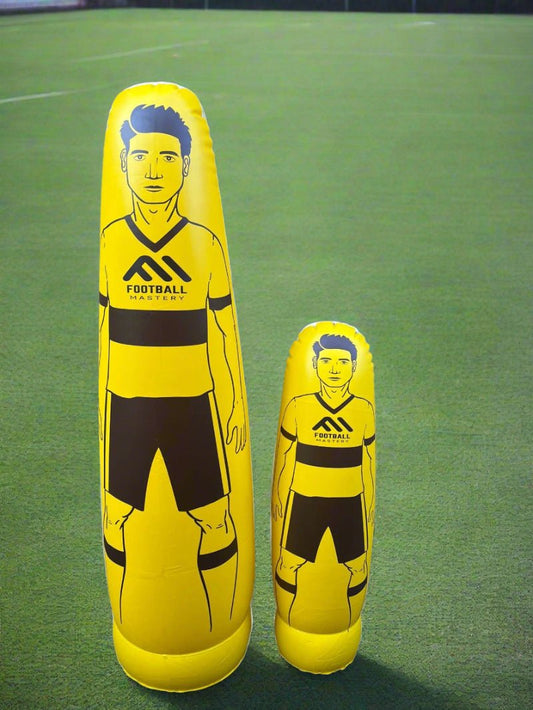
Unlike rebounders that return the ball, training mannequins simulate the opponent. A well-placed mannequin transforms any shooting or passing drill into a scenario with defensive wall simulation—forcing players to adapt their technique, decision-making, and timing.
Think about:
- A free kick practice drill with a wall of air mannequins
- A dribbling sequence weaving through mannequins as static defenders
- Practising finishing angles around a line of obstacles
- Building confidence with set-piece realism
Football mannequins bring purpose to your training by mimicking the unpredictability and spatial awareness demanded by real matches.
“When pressure is present—even if simulated—technique changes. That’s why mannequins matter.”
Explore our durable Air Mannequins x3, ideal for free kick walls, positional drills, and realistic open-play simulation.
A Word on Simulation Tools and Smart Sessions
The best sessions aren’t cluttered with gear—they’re built around intentional equipment choices. Whether you’re developing shooting under pressure, refining agility training, or working on precision passing, both rebound boards and mannequins offer massive value.
Rebounders vs. Mannequins: When to Use Each
So far, we've looked at the strengths of rebound boards and training mannequins individually. But let’s get into the real question—when is one better than the other?
The short answer: it depends on the outcome you’re training for.
Use Rebound Boards When You Want To:
- Improve passing technique and reaction time
- Build muscle memory through training repetition
- Sharpen your first touch or volley technique
- Enhance solo sessions with multi-angle return variations
- Train with limited space (e.g., gardens, smaller training grounds)
Rebounders excel at technique-building. The key is the consistency of the ball return, giving players the chance to tweak and perfect their timing, control and accuracy. They're also perfect for progressive drills where intensity ramps up over time—ideal for players building from fundamentals to advanced execution.
“Think of rebounders as the ‘mirror’ to your technique—they reflect every detail back at you.”
They’re also essential for indoor or outdoor solo training where you don’t have access to teammates or coaches. A well-set-up rebound station can form the core of a high-quality, independent training programme.
Use Mannequins When You Want To:
- Simulate defenders in shooting or dribbling drills
- Practice free kicks against a realistic defensive wall
- Train under spatial pressure for better positional awareness
- Create real-game scenarios in team or individual sessions
- Introduce obstacle simulation into agility and finishing drills
Training mannequins are best when pressure or positional constraints are needed. They’re the bridge between isolated technique and match simulation. Whether you're setting up for a whipping free kick or placing mannequins in the box for striker movement drills, you're introducing realistic elements into practice.
They're also excellent for group training, enabling players to make more intelligent runs, improve player movement replication, or even simulate late defenders arriving into the box.
Blending Both: Smart Session Design
For coaches or players looking to maximise every drill, the best sessions don’t choose between the two—they combine rebound boards and mannequins in ways that mimic real football patterns.
Here’s how:
Example Drill #1: One-Two + Finishing with Obstacle
- Use a rebound board to simulate a give-and-go pass.
- Player receives the return and then navigates a mannequin obstacle before shooting.
- Adjust mannequin placement to shift finishing angles and increase difficulty.
Example Drill #2: Free Kick Precision
- Set up a mannequin wall just outside the box.
- Place a target net in goal or behind the wall.
- Repeat reps, adjusting for spin, curl, and trajectory.
Example Drill #3: Passing into Pressure
- Use cones or passing arcs to frame your starting position.
- Pass into a rebound net for ball return.
- React and make your next move with mannequins acting as passive defenders.
These drills combine technical drills, agility training, and set-piece practice in one. The result? A dynamic, versatile training experience.
What to Consider Before You Buy
Whether you’re a grassroots coach, academy trainer, or an individual player, choosing the right equipment should align with your training goals, available space, and session type.
Ask Yourself:
- Am I training solo or with a team?
- Do I need repetition and precision, or realistic pressure?
- Am I focusing on free kicks, passing, finishing, or all of the above?
- Do I have space for portable rebounders, or do I need a static setup?
- Will this tool be used primarily in outdoor or indoor settings?
“Your answer doesn’t need to be either/or. It can—and often should—be both.”
Final Comparisons, Top Drills & Buyer’s Guide
Now that we've explored the strengths, use cases, and smart combinations of rebound boards and training mannequins, let’s wrap up this guide with a practical comparison, a selection of top drills, and a buyer’s guide tailored to your needs.
Feature Showdown: Rebound Boards vs Training Mannequins
| Feature | Rebound Boards | Training Mannequins |
|---|---|---|
| Primary Use | Passing, control, shooting, reaction drills | Free kick training, defensive simulation, dribbling under pressure |
| Ball Return | Yes – with predictable bounce or varied returns | No – static obstacles only |
| Adjustability | Often angle-adjustable for ground or aerial rebounds | Fixed height (some models vary), used for positional obstacles |
| Portability | High – many are foldable or lightweight | Moderate – depends on model (e.g. foam vs air mannequins) |
| Solo Training Friendly | Extremely – ideal for solo practice tools | Less so – best with a coach or multiple training items |
| Simulation of Opponents | Not designed for this | Yes – mimics static defenders, walls, or player positioning |
| Best For | Technical drills, passing, volleys, reaction training | Set-piece realism, free kicks, finishing under pressure |
| Drill Versatility | Very high – can be used with other tools for complete sessions | High – works well when combined with goals, cones, or rebounders |
Top Drills for Each Equipment Type
Whether you're a coach or an individual player, here’s a breakdown of high-value drills that utilise these tools effectively.
⚽ Best Rebound Board Drills
One-Touch Passing Drill
- Stand 5–7m from your rebound board
- Pass and receive on the move
- Focus on accuracy and tempo for precision passing
Volley and Reaction Challenge
- Use angled board setting for aerial rebound
- Strike the ball on the return before it hits the ground
- Develops reaction training and volley technique
Pass, Turn, and Finish
- Pass into the rebound board, receive, turn, and shoot into a net or target
- Great for solo training and first-touch improvement
🧍 Best Mannequin Drills
Free Kick Accuracy with Wall
- Set up 3 air mannequins
- Place ball 20–25 yards out
- Practice curling the ball around or over the wall for set-piece training
Dribble Through & Finish
- Arrange mannequins in a zig-zag
- Dribble through with close control and finish on goal
- Focus: footwork development and shooting under pressure
Obstacle Passing Drill
- Place mannequins across the pitch as passive defenders
- Weave in and out with precise passes or touches
- Mimics player movement replication in congested areas
Who Should Choose What? – A Buyer’s Guide
Here’s a quick guide based on player type, level, and training goals:
⚽ For Solo Players at Home
- Must-have: Rebound board or portable rebounders
- Why: You can build full sessions with just a board and ball.
- Consider adding: Cones for agility and passing arcs.
⚽ For Coaches and Teams
- Must-have: Training mannequins + rebounders
- Why: You need both technical development and game simulation tools.
- Suggested bundle: Football Mastery Bundles
⚽ For Set-Piece Specialists
- Must-have: Air Mannequins x3
- Why: Recreates defensive wall simulation, ideal for free kicks.
⚽ For Young Players / Juniors
- Look for lightweight, safe, and compact tools.
- Use foam mannequins and small rebound boards to ease control and handling.
Final Word: Practice with Purpose
In the end, the debate of Football Rebound Boards or Training Mannequins: What to Use isn’t about choosing one over the other—it’s about recognising the different outcomes they’re designed to produce.
- Use rebounders when you want sharpness, control, and isolated technical focus.
- Use mannequins when you want game pressure, obstacles, and realism.
“Your sessions are only as strong as your tools—and your intent behind them.”
Whether you're building a backyard training station or planning structured team sessions, investing in the right football training equipment will help you or your players reach that next level of performance.
For premium, coach-approved equipment that performs session after session, visit Football Mastery.
Frequently Asked Questions
About Football Rebound Boards or Training Mannequins: What to Use
1. Can rebound boards be used indoors as well as outdoors?
Yes, many rebound boards are suitable for both indoor and outdoor use, especially those with rubberised bases or non-slip feet. If you're using it indoors, ensure the surface is flat and the board won’t damage flooring. Lightweight or pop-up rebounders are perfect for indoor use.
2. How much space do I need to use a rebound board effectively?
It depends on the type of drills you’re doing. For close-range passing and first-touch work, 3–5 metres of space is sufficient. For shooting drills or aerial returns, aim for 7–10 metres. The more space you have, the more versatile your sessions will be.
3. Can I use a rebound board and training mannequin together in one drill?
Absolutely. Combining the two offers technical precision and spatial awareness. For example, you can pass into a rebound board, receive the return, dribble around a mannequin, and finish on goal. It’s a great way to simulate real-game scenarios.
4. Are there specific drills for goalkeepers using these tools?
Yes. Goalkeepers can use rebound boards to simulate unpredictable deflections or rapid reaction saves. Training mannequins can be used to obstruct vision or mimic attackers in crossing and shot-stopping drills.
5. How do I secure mannequins on different playing surfaces?
Most mannequins include spikes for grass and weighted bases or sandbag attachments for artificial turf or indoor flooring. If you’re using them indoors, opt for mannequins with foam or air-filled designs that won’t damage surfaces.
6. Do rebound boards work with size 3 or size 4 balls for younger players?
Yes, rebound boards work across all ball sizes. Just ensure the board surface and angle are appropriate for the ball's weight and bounce. Many younger players benefit from smaller boards designed for controlled, close-range passing.
7. How long do rebound boards and mannequins typically last?
With proper care, both can last several years. Boards made from weather-resistant materials and galvanised frames are highly durable. Mannequins made of PVC, foam, or high-quality vinyl also stand up to regular use if stored correctly.
8. What’s the best way to maintain these training tools?
- Rebound boards: Wipe down after use, store dry, avoid heavy impacts to edges.
-
Mannequins: Keep clean, deflate air mannequins slightly when not in use, and avoid prolonged sun exposure if possible.
Store both in a cool, dry place to avoid wear from moisture or UV.
9. Are these tools suitable for all age groups?
Yes. There are different models to suit all age groups. For younger players, use junior-sized mannequins and lightweight rebounders. Senior players may prefer full-sized equipment with higher bounce power and greater resistance for realistic feedback.
10. Can I use a rebound board or mannequin for non-football sports?
Yes. Rebounders are often used in rugby, netball, cricket, and basketball for passing and reaction drills. Mannequins can be used as obstacle markers or for tactical walk-throughs in other sports as well.