

Football Speed Ladder vs Hurdles Which Training Tool Wins
Share
If you're trying to improve football speed and agility, both football speed ladders and football hurdles have a place in your training programme. Speed ladder training excels at developing coordination, footwork, movement efficiency and athletic agility, while hurdle drills for football are often superior for explosive power, acceleration training and reactive strength. The real winner depends on your training objective. Players looking to sharpen foot speed, balance and movement patterns may benefit more from agility ladder drills, whereas athletes seeking explosive acceleration, jumping ability and football-specific power development often gain greater returns from plyometric hurdle training. The most effective football performance training programmes combine both tools strategically.
Football Speed Ladder vs Hurdles Which Training Tool Wins?
Walk onto almost any training pitch and you'll likely see one of two pieces of football training equipment laid out on the grass: a football agility ladder or a row of football hurdles.
Both have become staples of modern football conditioning, both are praised by coaches across all levels of the game, and both claim to improve speed, agility and athletic performance.
Yet when players, coaches and parents are choosing football training tools, the same question repeatedly arises:
If you could only choose one, would speed ladder training or hurdle training deliver the greatest impact on football performance?
The answer isn't as straightforward as many believe.
To understand which tool deserves a place in your football speed training programme, we first need to understand what each one is actually designed to develop.
What Is a Football Speed Ladder?
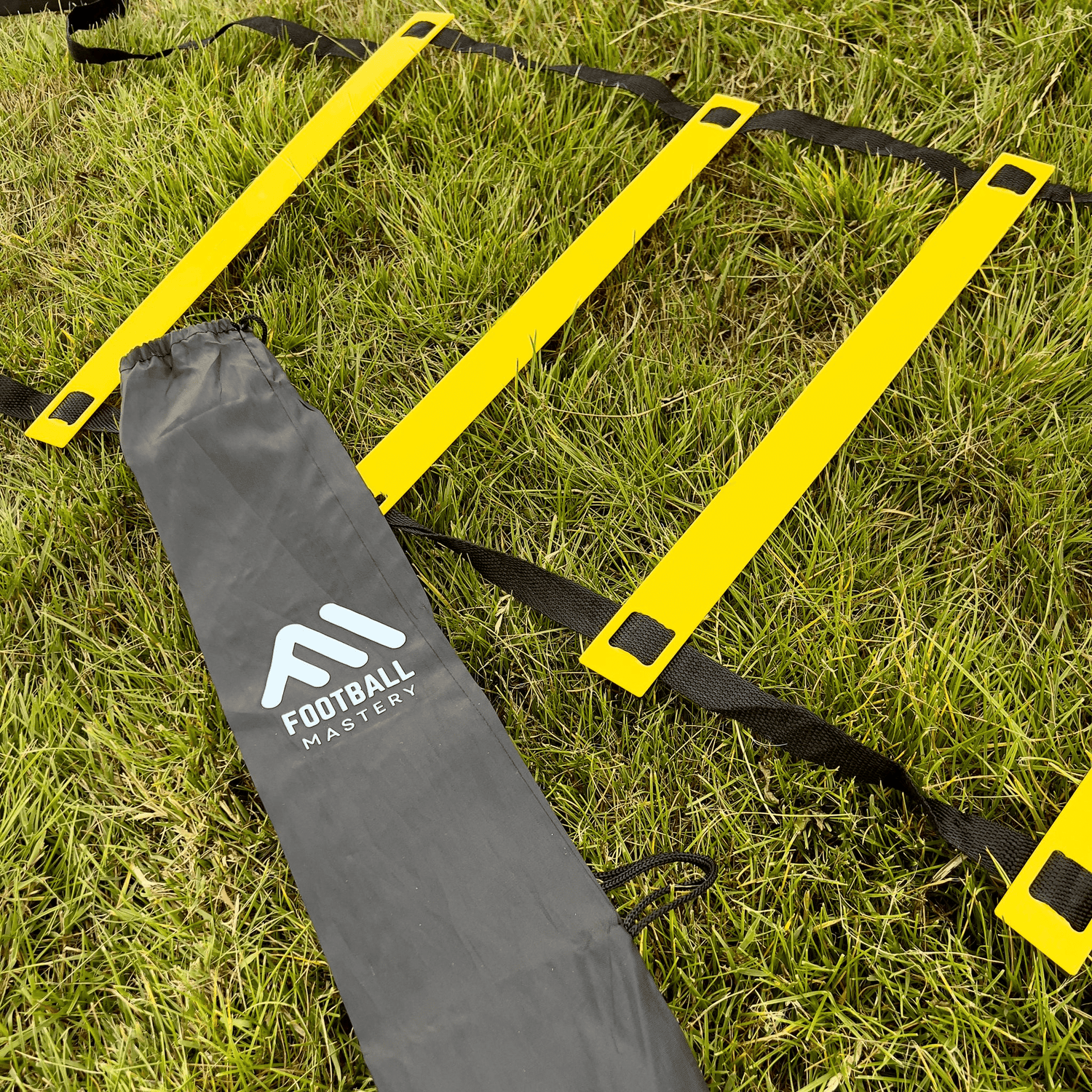
A football speed ladder, sometimes called a football agility ladder, is a flat ladder-shaped training aid placed on the ground to guide movement patterns through a series of structured footwork drills.
Many players begin their speed and agility training journey with a ladder because it provides an easy way to practise movement quality, coordination training and rhythm.
A quality ladder, such as the 3m Agility Ladder, allows players to perform a wide variety of agility ladder exercises that challenge balance, foot speed and body control.
Common speed ladder exercises include:
- Single-step runs
- Two-feet-in drills
- Lateral shuffles
- Ickey shuffle patterns
- Carioca footwork drills
- In-and-out movements
- Crossover patterns
These drills can improve:
- Athletic coordination
- Movement efficiency
- Footwork
- Balance
- Reaction time
- Dynamic movement
- Neuromuscular training adaptations
For younger players especially, ladder work introduces fundamental movement skills that contribute to long-term athletic development.
Why Speed Ladder Training Became So Popular
The rise of speed ladder training wasn't accidental.
Coaches quickly realised that players often lacked basic movement competency. Before athletes could master explosive acceleration or complex change of direction skills, they needed better control over their own bodies.
Agility ladder drills offered a simple solution.
The benefits frequently associated with football ladder drills include:
Improved Footwork
Football is a game of constant adjustments.
Players are continually repositioning their feet before passing, shooting, tackling and changing direction.
Regular speed ladder workout sessions can improve the precision and efficiency of these movements.
Enhanced Coordination
One of the strongest arguments in favour of football agility training with ladders is improved coordination.
Repeated movement patterns teach athletes how to synchronise:
- Arms
- Legs
- Hips
- Trunk positioning
This can help create smoother movement patterns both on and off the ball.
Increased Movement Awareness
Many young footballers move inefficiently.
Ladder drills encourage athletes to become more aware of foot placement, posture and body positioning.
This heightened awareness can contribute to improved movement quality and better football movement training outcomes.
The Biggest Question: Do Agility Ladders Improve Speed?
This is where the debate becomes interesting.
Many players assume that because ladder drills look fast, they automatically improve sprint speed.
However, speed development and foot speed are not necessarily the same thing.
A player can move their feet rapidly through a ladder without significantly improving:
- Linear speed
- Sprint mechanics
- Sprint acceleration mechanics
- Top-end speed
- Horizontal force production
This has led many performance coaches to question speed ladder effectiveness when the primary goal is pure acceleration.
While ladders can improve coordination, rhythm and athletic agility, the transfer to sport-specific sprint performance is often limited compared with more explosive training methods.
That doesn't mean ladders are ineffective.
It simply means they may be solving a different problem.
Instead of directly increasing sprinting speed, ladders often enhance the movement foundations that support broader football athlete development.
Where Speed Ladders Shine in Football Training
Rather than viewing ladders as a speed tool, many elite coaches now use them as a movement preparation tool.
They are particularly effective for:
- Youth football development
- Warm-up routines
- Athletic coordination training
- Movement pattern rehearsal
- Cognitive agility development
- Reaction drills
- Football quickness training drills
For younger players learning fundamental movement skills, the benefits can be substantial.
This is why many coaches incorporate ladders into broader training systems and player development packages available through specialised football training providers such as Football Mastery Bundles.
However, as players become more advanced, another piece of equipment often begins to play a larger role in football performance optimisation.
Football hurdles.
And this is where the debate starts to shift dramatically.
Why Football Hurdles Have Become a Favourite of Performance Coaches
While football speed ladders dominate many grassroots training sessions, football hurdles are often the preferred choice of strength and conditioning coaches focused on developing explosive athletes.
Unlike ladder drills, which largely emphasise coordination and footwork, hurdle drills for football place greater demands on force production, power output and athletic explosiveness.
This distinction is important.
Football is not simply about moving your feet quickly.
The game rewards players who can:
- Accelerate rapidly
- Decelerate efficiently
- Change direction explosively
- Win physical duels
- Produce repeated high-intensity efforts
These qualities are heavily influenced by an athlete's ability to generate force into the ground.
Football hurdles are specifically designed to target these athletic attributes.
What Football Hurdles Actually Train
When a player performs a hurdle exercise, they must overcome gravity, generate explosive power and absorb landing forces before repeating the movement.
This creates a training environment that develops several performance qualities simultaneously.
Explosive Power
Explosive power is one of the most valuable athletic qualities in modern football.
Whether sprinting into space, attacking a loose ball or rising for a header, players constantly rely on rapid force production.
Hurdle drills can help improve:
- Lower body power
- Vertical jump training capacity
- Horizontal power
- Rate of force development (RFD)
- Explosive movement training
These adaptations often have a stronger connection to match performance than simply improving foot speed.
Reactive Strength
Reactive strength refers to how quickly an athlete can absorb force and then reapply it.
In football, this happens constantly.
Examples include:
- Changing direction
- Landing from jumps
- Recovering after tackles
- Accelerating from a standing start
Plyometric hurdles challenge the body's ability to minimise ground contact time while maintaining explosive output.
The result is often improved football explosiveness and more efficient movement during high-speed actions.
Acceleration Training
One of the strongest arguments in favour of hurdles is their relationship with acceleration.
Football is rarely played at maximum sprint speed for long distances.
Most decisive moments occur over:
- 5 metres
- 10 metres
- 20 metres
Winning these short-distance races frequently comes down to first-step quickness and explosive acceleration.
Many hurdle exercises reinforce the same athletic qualities required for:
- Sprint training
- Acceleration drills
- Sprint technique development
- Running mechanics
- Explosive first-step performance
For players wondering how to improve football acceleration, hurdles often provide greater direct transfer than traditional ladder work.
The Science Behind Hurdle Training Benefits
The effectiveness of hurdle training largely comes down to biomechanics.
Every explosive jump requires athletes to create significant force against the ground.
The stronger and faster that force is produced, the more powerful the resulting movement becomes.
This relationship is often described through:
- Ground reaction force
- Elastic strength
- Reactive strength
- Force absorption
- Eccentric strength
Elite footballers excel because they can rapidly absorb force before redirecting it into powerful movement.
Hurdle training develops this athletic capacity repeatedly.
This is one reason many sports performance equipment programmes feature hurdles prominently within advanced football strength and conditioning systems.
How Hurdles Improve Football-Specific Performance
Perhaps the greatest advantage of hurdles is their ability to replicate demands commonly experienced during matches.
Football is full of explosive actions such as:
- Accelerating into space
- Pressing opponents
- Changing direction under pressure
- Jumping for aerial duels
- Recovering defensively
Well-designed hurdle exercises can reinforce many of these physical qualities.
Examples include:
Lateral Hurdle Hops
These develop:
- Lateral quickness
- Multidirectional movement
- Athletic agility
- Reactive agility
Single-Leg Hurdle Jumps
These challenge:
- Unilateral power
- Balance
- Athletic coordination
- Force absorption
Repeated Hurdle Bounds
These can improve:
- Speed endurance
- Explosive acceleration
- Horizontal force production
- Football conditioning
The result is often greater athletic transfer than exercises focused solely on foot placement patterns.
Are Hurdles Better Than Agility Ladders?
This is where the conversation becomes more nuanced.
Many coaches answer this question with a simple "yes".
But that answer misses an important point.
The purpose of training determines the value of the tool.
Consider the following comparison:
| Training Goal | Speed Ladder | Football Hurdles |
|---|---|---|
| Footwork drills | Excellent | Moderate |
| Coordination training | Excellent | Good |
| Movement awareness | Excellent | Good |
| Athletic coordination | Excellent | Good |
| Explosive power | Moderate | Excellent |
| Acceleration training | Limited | Excellent |
| Reactive strength | Limited | Excellent |
| Plyometric training | Poor | Excellent |
| Sprint mechanics | Limited | Good |
| Football explosiveness | Moderate | Excellent |
| Change of direction | Good | Excellent |
| Athletic transfer | Moderate | Excellent |
Viewed this way, the speed ladder vs hurdles debate becomes much clearer.
Ladders often excel at developing movement skills.
Hurdles frequently excel at developing athletic qualities.
The best football performance training programmes understand that both matter.
The Hidden Limitation of Hurdle Training
Despite their advantages, hurdles are not a complete solution.
Some players become obsessed with jumping higher and moving explosively while neglecting movement quality.
This can create issues such as:
- Poor footwork
- Inefficient movement patterns
- Reduced coordination
- Technical breakdown under pressure
Power without control rarely produces elite football performance.
A player capable of generating enormous force but unable to organise their movement effectively may struggle to translate physical abilities into game situations.
This is why experienced coaches often combine multiple forms of football training equipment rather than relying on a single tool.
For younger players in particular, combining movement education with power development creates a stronger athlete development pathway.
Many youth development programmes therefore incorporate a variety of equipment from dedicated collections such as Kids Football Coaching Equipment, allowing players to build coordination, agility and explosiveness simultaneously.
The Real Problem With Asking Which Tool Wins
The question itself may be flawed.
When players search for the best football training equipment, they're often looking for a single solution.
But football performance is built from multiple physical qualities working together.
A complete athlete requires:
- Coordination
- Agility
- Acceleration
- Explosive power
- Decision-making speed
- Movement efficiency
- Sport-specific agility
- Reactive agility
No single piece of equipment can develop all of these qualities equally.
The smarter question is not:
"Which is better, ladders or hurdles?"
Instead, ask:
"Which tool develops the quality I need most right now?"
The answer can vary dramatically depending on age, experience level and performance goals.
Which Tool Is Better for Different Ages and Ability Levels?
One reason the football speed ladder vs hurdles debate continues is because different players have different developmental needs.
A seven-year-old beginner and a semi-professional footballer are not trying to solve the same performance problems.
The most effective football training tools are those that address the athlete's current stage of development.
Young Players (Ages 6–12)
For younger athletes, coordination and movement competency should typically come before advanced power development.
At this stage, football agility training should focus on:
- Balance
- Coordination
- Movement quality
- Basic footwork drills
- Athletic agility
- Motor skill development
A football agility ladder is often an excellent choice because it introduces movement patterns in a structured and enjoyable way.
Young players can learn:
- Body control
- Rhythm
- Spatial awareness
- Multidirectional movement
- Basic change of direction skills
This creates a foundation that supports future athletic development.
Developing Players (Ages 13–16)
As players mature physically, training priorities begin to shift.
Movement quality remains important, but athletes can now benefit from greater exposure to:
- Acceleration training
- Plyometric training
- Reactive agility
- Explosive movement training
- Speed work
This is often where football hurdles become increasingly valuable.
Developing players can begin building:
- Explosive acceleration
- Lower body power
- Elastic strength
- Football-specific movement capacity
At this stage, combining agility ladder drills with hurdle exercises frequently produces the best results.
Advanced Players
For older and more advanced footballers, the emphasis often shifts towards athletic transfer.
Training must closely resemble the physical demands of competition.
Advanced players usually benefit from:
- Game-speed training
- Sprint mechanics work
- Reactive strength development
- Deceleration training
- Sport-specific agility
- Football performance optimisation
Here, hurdles often take on a larger role because they can better replicate the explosive demands of football.
However, ladders still retain value as part of warm-ups, coordination sessions and movement preparation.
How Elite Footballers Use Both Tools
One of the biggest misconceptions in football conditioning is that ladders and hurdles compete against each other.
In reality, many elite environments use both.
A professional training session might follow a progression such as:
Phase 1: Movement Preparation
Using ladder drills to improve:
- Athletic coordination
- Footwork
- Neuromuscular training
- Movement efficiency
Phase 2: Power Development
Using hurdles for:
- Plyometrics
- Explosive power
- Reactive strength
- Force production
Phase 3: Sprint Integration
Applying new physical qualities through:
- Sprint training
- Acceleration drills
- Speed drills for football
- Football movement training
Phase 4: Football-Specific Application
Integrating movement into:
- Small-sided games
- Reactive agility drills
- Decision-making exercises
- Match-realistic scenarios
This progression helps bridge the gap between training and performance.
In other words, the best coaches don't choose between ladders and hurdles.
They understand when each tool should be used.
Sample Football Speed and Agility Workout
If your goal is complete football speed and agility development, a combined approach often works exceptionally well.
Warm-Up
- Dynamic mobility work
- Light jogging
- Movement activation
Ladder Section
Perform:
- Two-feet-in drill x 2 rounds
- Lateral shuffle x 2 rounds
- Ickey shuffle x 2 rounds
- In-and-out drill x 2 rounds
Focus on:
- Coordination
- Foot speed
- Balance
- Movement quality
Hurdle Section
Perform:
- Double-leg hurdle hops x 3 sets
- Lateral hurdle jumps x 3 sets
- Single-leg hurdle hops x 2 sets per leg
Focus on:
- Reactive strength
- Explosive power
- Ground contact time
- Horizontal power
Sprint Section
Complete:
- 4 x 10-metre accelerations
- 4 x 20-metre accelerations
- 3 x change of direction sprints
Focus on:
- Sprint acceleration mechanics
- First-step quickness
- Linear speed
- Top-end speed
Football Application
Finish with:
- 1v1 drills
- Small-sided games
- Reactive possession exercises
This final stage is where true athletic transfer occurs.
So, Which Training Tool Wins?
After examining the evidence, there is no universal winner.
Both tools deliver value.
However, they deliver different types of value.
Choose a Football Speed Ladder If You Want To Improve:
- Footwork
- Coordination
- Athletic agility
- Movement awareness
- Balance
- Neuromuscular efficiency
- Movement pattern development
Choose Football Hurdles If You Want To Improve:
- Explosive power
- Acceleration
- Reactive strength
- Plyometric ability
- Lower body power
- Sprint performance
- Football explosiveness
Choose Both If You Want Maximum Results
This is ultimately the conclusion reached by many experienced coaches.
Football is too complex for a single training solution.
Players need:
- Technical skill
- Tactical understanding
- Athleticism
- Speed
- Agility
- Power
- Coordination
Ladders and hurdles simply develop different pieces of the puzzle.
Final Verdict
When viewed through the lens of pure football athletic performance, football hurdles often provide greater direct transfer to acceleration, explosive power and match-winning athletic actions.
If the objective is to become faster, more powerful and more explosive, hurdles generally offer the stronger return on investment.
However, dismissing speed ladder training entirely would be a mistake.
Football speed ladders remain highly effective for developing coordination, footwork, movement quality and athletic foundations, particularly in younger players and developing athletes.
The true winner of the football speed ladder vs hurdles debate is not one tool or the other.
It is the player who understands how to use both strategically.
The most complete footballers are not built through a single method.
They are developed through intelligent football conditioning, progressive speed and agility training, and a commitment to improving every aspect of athletic performance.
When ladders develop control and hurdles develop power, the combination creates a more complete athlete—and that is what ultimately wins matches.
Frequently Asked Questions
1. How often should football players use speed ladders and hurdles?
Most footballers can benefit from using speed ladders and hurdles 2–3 times per week as part of a structured football speed and agility programme. Younger players may focus more heavily on coordination and agility ladder drills, while older athletes can increase their emphasis on hurdle-based plyometric training and acceleration work. Adequate recovery should always be included to maximise performance gains.
2. Can speed ladders and hurdles be used in the same training session?
Yes. In fact, combining both tools within the same session is often highly effective. Many coaches begin with football agility ladder exercises to improve coordination and movement preparation before progressing to hurdle drills that focus on explosive power, reactive strength and acceleration. This creates a logical progression from movement quality to athletic performance.
3. What is the best football speed ladder drill for beginners?
The two-feet-in drill is often considered one of the best football ladder drills for beginners. It teaches rhythm, coordination and foot placement without overwhelming younger or less experienced players. Once mastered, players can progress to lateral shuffles, in-and-out drills and crossover patterns.
4. What height hurdles should football players use?
The ideal hurdle height depends on age, experience and training objectives. Younger players often benefit from mini hurdles between 6 and 15 inches high, while older players may use higher hurdles for advanced plyometric training. The goal should always be maintaining proper movement quality rather than simply clearing the tallest obstacle possible.
5. Are speed ladders suitable for goalkeepers?
Absolutely. Goalkeepers can use football agility ladders to improve footwork, balance, reaction time and lateral movement. Efficient foot positioning is crucial for diving, recovering and adjusting to shots, making ladder training a valuable addition to goalkeeper development programmes.
6. Can hurdle training help reduce injury risk?
When performed correctly, hurdle training can strengthen muscles, tendons and joints involved in explosive movement. Plyometric exercises can improve force absorption, landing mechanics and eccentric strength, all of which contribute to more resilient athletic movement. However, training should always be progressed gradually and performed with proper technique.
7. Which tool requires less training space?
Speed ladders generally require less space than hurdle-based sprint and plyometric drills. A football speed ladder can be used in a garden, small training area or indoor facility, making it a practical option for players training at home. Hurdle sessions often require additional room for jumps, acceleration and movement progressions.
8. Do professional football academies use speed ladders and hurdles?
Yes. Professional academies frequently incorporate both tools within their football athlete development systems. Speed ladders are commonly used for movement preparation, coordination and activation, while hurdles are utilised for power development, reactive strength and athletic conditioning.
9. Can football hurdles improve jumping ability?
Yes. Football hurdles are widely used for vertical jump training and plyometric development. Regular hurdle exercises can help improve lower body power, elastic strength and explosive movement capacity, which may translate into better aerial performance during matches.
10. What should players focus on more: speed, agility or power?
The answer depends on the player's strengths and weaknesses. A player with excellent coordination but limited explosiveness may benefit more from hurdle training and power development. Conversely, a player with good athleticism but poor footwork may gain more from agility ladder exercises. The most complete footballers develop speed, agility, power and movement efficiency together rather than prioritising one quality exclusively.