

How to Use Resistance Bands for Football Speed and Strength Training
Share
Resistance bands have become an essential tool in modern football athletic training because they develop explosive power, sprint acceleration and functional strength without requiring a fully equipped gym. Used correctly, they can enhance first-step quickness, improve sprint mechanics, strengthen key muscle groups including the glutes, hamstrings and hip flexors, and support football injury prevention. This guide explains how footballers can integrate resistance band exercises into warm-ups, speed sessions and strength workouts to maximise athletic performance on the pitch.
Football is no longer won solely through technical ability. The modern game demands explosive starts, rapid changes of direction, relentless speed endurance and the physical resilience to perform consistently across ninety minutes.
Whether you're a youth player looking to sharpen your acceleration or an experienced footballer aiming to increase lower-body power, resistance bands offer a versatile and highly effective training method.
Unlike traditional weights, resistance bands create variable tension throughout a movement. This forces the body to recruit stabilising muscles, improve neuromuscular coordination and develop force production patterns that directly transfer to football performance.
For players seeking effective football strength training without access to a gym, bands deliver a practical solution that fits into any training environment.
Why Resistance Bands Are So Effective for Footballers
Football is a multidirectional sport. Players sprint, decelerate, jump, tackle, pivot and strike the ball repeatedly throughout a match.
Traditional strength exercises remain valuable, but functional resistance training bridges the gap between gym-based strength and on-pitch performance.
Resistance bands challenge the entire kinetic chain by requiring constant control through every phase of movement.
This improves:
- Sprint acceleration
- Change of direction speed
- Lateral speed
- Core stability
- Single-leg stability
- Rotational power
- Force absorption
- Running economy
- Reactive strength
- Muscular endurance
For footballers, the greatest benefit lies in movement specificity.
Band exercises closely mimic the demands of sprinting, pressing, tackling and striking the ball.
As a result, players can develop:
- Faster explosive starts
- Improved sprint efficiency
- Greater lower-body strength
- Enhanced football mobility exercises
- Better balance during multidirectional movement
- Increased football explosiveness training capacity
Resistance training for football should enhance movement quality, not compromise it. The goal is to become stronger while maintaining speed, coordination and technical efficiency.
The Science Behind Band Training and Football Performance
When sprinting, players need to generate force quickly.
This quality is known as the rate of force development (RFD).
The faster an athlete can produce force into the ground, the greater their acceleration mechanics and sprint speed.
Resistance bands improve this process by increasing tension during explosive movements while maintaining sport-specific movement patterns.
This encourages adaptations linked to:
- Horizontal force application
- Sprint force production
- Reduced ground contact time
- Enhanced stretch-shortening cycle efficiency
- Improved football biomechanics
- Greater explosive power output
Bands are particularly effective for developing the posterior chain, which includes the:
- Glutes
- Hamstrings
- Calves
- Lower back
- Core muscles
A stronger posterior chain contributes directly to:
- Faster acceleration drills
- Increased jumping power
- Improved deceleration training
- Better knee stability
- Reduced risk of hamstring injuries
Players who consistently include resistance bands for football within their weekly routine often notice improvements in both athletic performance and recovery.
Choosing the Right Resistance Bands for Football Training
Not all bands are created equally.
The ideal setup depends on your age, strength levels and training objectives.
Generally, footballers benefit from having multiple resistance levels available.
Light Resistance
Best suited for:
- Football warm-up exercises
- Dynamic stretching
- Glute activation
- Ankle flex exercises
- Recovery training
- Pre-activation exercises
Medium Resistance
Ideal for:
- Resistance band drills
- Lateral movement drills
- Core stability exercises
- Hip stability work
- Football conditioning sessions
Heavy Resistance
Most effective for:
- Resisted sprints
- Lower-body power development
- Football sprint training
- Banded plyometrics
- Eccentric hamstring training
- Football power training
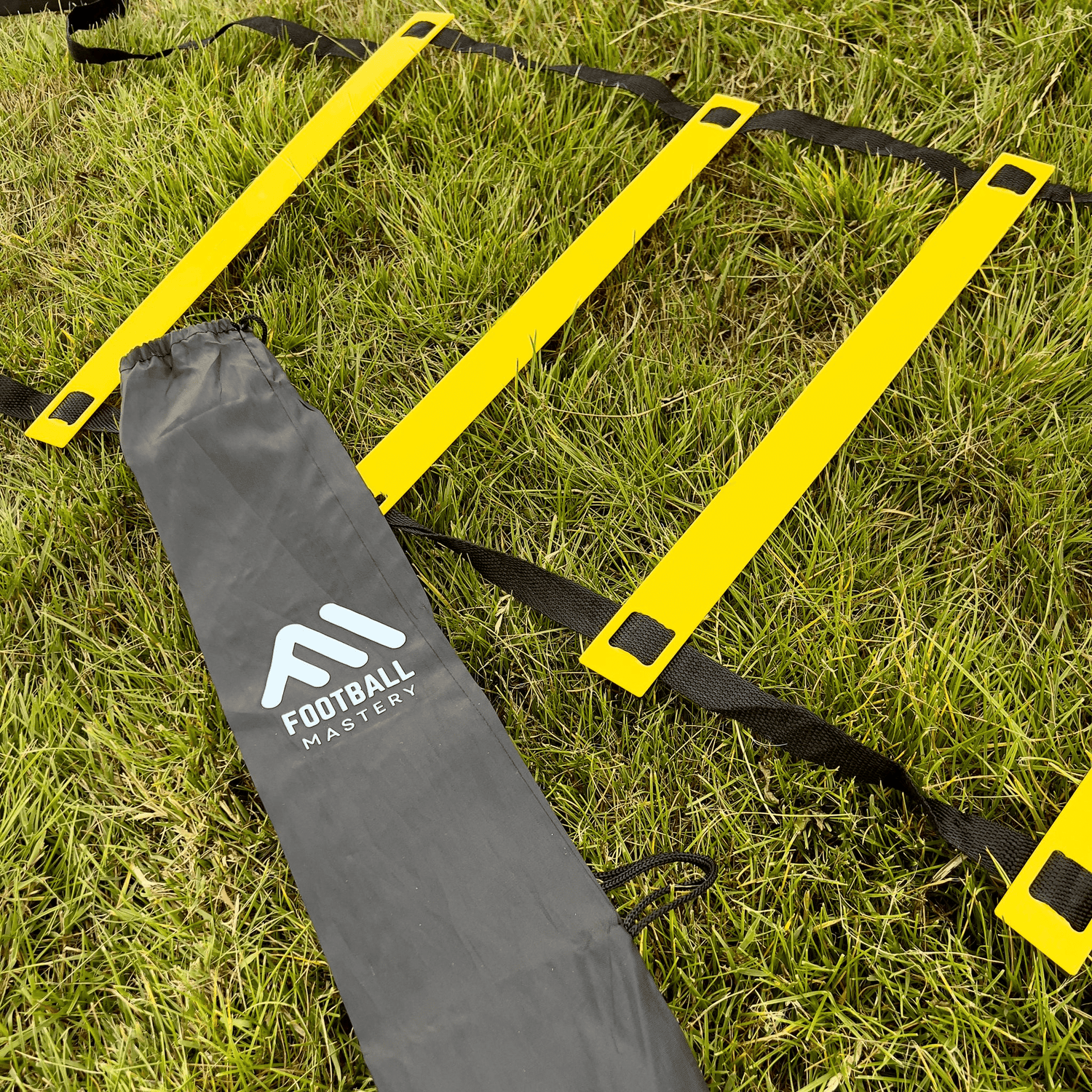
If you're building a complete home setup, combining resistance bands with equipment such as an agility ladder creates a more rounded speed and coordination programme.
Players training with siblings, teammates or across different age groups may benefit from the versatility offered by the complete range of equipment available through the Football Mastery bundles collection.
Preparing Your Body: The Ideal Resistance Band Warm-Up for Football
Many players make the mistake of treating warm-ups as an afterthought.
An effective resistance band warm-up elevates body temperature while preparing the muscles and nervous system for high-speed actions.
The objective is simple:
- Activate key muscle groups
- Increase mobility
- Improve reaction speed
- Enhance sprint mechanics
- Reduce injury risk
Focus particularly on activating the:
- Hip flexors
- Glutes
- Hamstrings
- Adductors
- Calves
- Core muscles
- Ankle complex
Five-Minute Band Activation Routine
Perform each exercise for 30 seconds.
- Lateral band walks
- Crab walks
- Donkey kicks
- Hip raises
- Jumping jacks with bands
- Side steps
- Leg raises
- Calf raises
This sequence improves hip strength, ankle stability and muscular readiness before speed sessions or technical training.
For younger players, introducing resistance work gradually alongside age-appropriate equipment from the kids football coaching equipment collection can build sound movement patterns early while keeping sessions engaging.
Resistance Band Sprint Drills for Football
Raw speed is valuable, but acceleration wins more moments in football.
The ability to explode over the first five to ten metres often determines who reaches the ball first, creates separation from a defender or recovers possession.
This is where resistance band drills become particularly effective.
Unlike traditional sprint training, bands increase horizontal resistance, forcing players to apply greater force into the ground during acceleration.
Over time, this improves:
- First-step quickness
- Sprint acceleration
- Sprint mechanics
- Sprint force production
- Explosive starts
- Running economy
- Maximal velocity training
- Football sprint training performance
The key is selecting the right level of resistance.
Too much tension alters movement quality. Too little fails to create a meaningful training stimulus.
As a rule, athletes should maintain natural sprint mechanics throughout every drill.
If resistance changes your running posture or shortens your stride excessively, reduce the load immediately.
Resisted Sprints
Resisted sprints are one of the most effective exercises for improving acceleration mechanics.
Attach the band securely around your waist and sprint for short distances while maintaining a forward body lean.
How to perform:
- Anchor the band behind you.
- Lean slightly forward from the ankles.
- Drive aggressively through the arms.
- Push the ground away with each step.
- Sprint for 10–20 metres.
Recommended volume:
- 4–6 repetitions
- 60–90 seconds rest between efforts
Focus on powerful knee drive and strong arm action rather than maximum speed.
The objective is force production, not fatigue.
Sprint Holds
Sprint holds teach players how to maintain optimal body positioning during acceleration.
This drill develops:
- Core stability
- Hip strength
- Ankle stability
- Sprint efficiency
- Neuromuscular training capacity
How to perform:
- Anchor the resistance band behind you.
- Drive into a sprint position.
- Hold the position for 10–15 seconds.
- Switch legs and repeat.
Maintain tension throughout the body, particularly through the glutes, core muscles and hip flexors.
Standing Sprint Drill
The standing sprint drill reinforces proper acceleration mechanics while improving reaction speed.
Begin from a stationary position before driving explosively against the band's resistance.
Concentrate on:
- Explosive arm action
- Aggressive ground contact
- Forward body angle
- Fast leg turnover
Perform:
- 3–5 sets
- 10-second efforts
Overspeed Training Considerations
Advanced players occasionally incorporate overspeed training using bands to expose the body to higher movement velocities.
This method should only be introduced once athletes have developed excellent sprint mechanics and adequate lower-body strength.
Overspeed work is designed to improve:
- Stride frequency
- Maximal sprint speed
- Ground contact time
- Reactive strength
However, poor technique under assisted conditions increases injury risk.
For most footballers, resisted sprint training delivers greater returns.
Resistance Band Agility Drills for Footballers
Football rarely involves running in straight lines.
Players constantly accelerate, decelerate and change direction in response to teammates, opponents and the ball.
Effective football agility training should therefore focus on multidirectional movement patterns.
Resistance bands challenge balance and coordination while strengthening the stabilising muscles responsible for efficient movement.
This supports:
- Change of direction speed
- Deceleration training
- Lateral speed
- Reaction speed
- Single-leg stability
- Football conditioning
Speed Shuffle
The speed shuffle improves defensive footwork and lateral acceleration.
How to perform:
- Place a loop band around your ankles.
- Adopt an athletic stance.
- Shuffle laterally for 10–15 metres.
- Stay low throughout the movement.
Avoid crossing your feet.
Maintain tension in the band at all times.
Lateral Band Walks
Lateral band walks are highly effective for glute activation and hip stability.
Strong glutes support:
- Sprint mechanics
- Knee stability
- Groin strengthening
- Injury prevention exercises
Perform:
- 2–3 sets
- 12–15 steps each direction
Keep your chest upright and knees slightly bent.
Running Man Drill
This exercise develops coordination between the upper and lower body while reinforcing sprint-specific movement patterns.
The running man drill improves:
- Balance
- Acceleration mechanics
- Core stability
- Football biomechanics
Drive one knee upward while the opposite arm swings forward.
Return slowly under control before repeating.
Side Steps
Side steps strengthen the adductors and groin muscles while improving lateral movement efficiency.
This exercise is particularly beneficial for wide players and defenders who frequently perform rapid directional changes.
Aim for:
- 2–4 sets
- 20 seconds per set
Building Lower-Body Strength with Resistance Bands
Explosive football actions begin with lower-body power.
Jumping, sprinting, tackling and striking the ball all depend on the ability to generate force quickly.
Resistance bands provide a highly effective method for building functional strength without excessive joint stress.
Unlike fixed machines, bands challenge the body through multiple planes of movement.
This develops:
- Lower-body strength
- Functional strength
- Unilateral strength
- Muscular endurance
- Athletic performance
- Power development
Wide Squats
Wide squats target the:
- Quadriceps
- Glutes
- Hamstrings
- Adductors
The wider stance also enhances groin strengthening and hip mobility.
Perform:
- 3 sets
- 10–15 repetitions
Drive through the heels and maintain a neutral spine throughout the exercise.
Donkey Kicks
Donkey kicks isolate the glutes while improving hip extension power.
Strong glutes contribute directly to:
- Sprint acceleration
- Jumping power
- Explosive starts
- Injury resilience
Complete:
- 2–3 sets
- 12 repetitions per leg
Pause briefly at the top of each repetition.
Hip Raises
Hip raises strengthen the posterior chain and improve force transfer between the lower and upper body.
This movement supports:
- Sprint speed
- Running economy
- Core stability
- Football power training
For added difficulty, perform the exercise on one leg to improve single-leg stability.
Calf Raises
Powerful calves are essential for efficient sprinting and rapid changes of direction.
Calf raises strengthen the ankle complex and Achilles tendon while improving force absorption.
Aim for:
- 3 sets
- 15–20 repetitions
Control both the upward and lowering phases.
The eccentric portion of the movement is particularly valuable for Achilles strengthening.
Building a Complete Resistance Band Workout for Football
Knowing individual exercises is useful, but consistent progress comes from following a structured plan.
The most effective football performance training programmes combine speed, strength, mobility and recovery throughout the week.
Rather than exhausting yourself in a single session, think of resistance bands as a tool for microdosing strength training — adding small, targeted doses of quality work around technical sessions and matches.
A balanced weekly schedule could look like this:
| Day | Focus | Key Exercises |
|---|---|---|
| Monday | Speed and acceleration | Resisted sprints, sprint holds, standing sprint drill |
| Tuesday | Strength and power | Wide squats, hip raises, donkey kicks, calf raises |
| Wednesday | Recovery and mobility | Dynamic stretching, lateral band walks, ankle flex exercises |
| Thursday | Agility and reaction | Speed shuffle, side steps, running man drill |
| Friday | Match-day activation | Glute activation, jumping jacks with bands, leg raises |
| Saturday | Match day | Pre-activation exercises only |
| Sunday | Recovery training | Football flexibility exercises and mobility work |
For most players, two to four resistance band sessions each week is enough to improve athletic performance without negatively affecting recovery.
Prioritise quality over quantity.
Each repetition should be explosive, controlled and technically sound.
The goal is not to feel exhausted at the end of every session. The goal is to move faster, become stronger and arrive on match day feeling sharp.
A 30-Minute Resistance Band Session for Footballers
If you're short on time, this full-body routine combines football speed training and football strength training into one efficient workout.
Warm-Up (5 Minutes)
Perform each exercise for 30 seconds:
- Lateral band walks
- Crab walks
- Jumping jacks with bands
- Hip raises
- Leg raises
Speed Block (10 Minutes)
Complete three rounds:
- Resisted sprints × 15 metres
- Sprint holds × 10 seconds each leg
- Standing sprint drill × 10 seconds
Rest for 60 seconds between rounds.
Strength Block (10 Minutes)
Complete three rounds:
- Wide squats × 12 repetitions
- Donkey kicks × 12 repetitions per leg
- Calf raises × 20 repetitions
- Side steps × 20 seconds
Rest for 45 seconds between rounds.
Power Finisher (5 Minutes)
Complete two rounds:
- Jump kicks × 10 repetitions
- Power kicks × 10 repetitions each leg
- Running man drill × 20 seconds
Focus on maximum intent during every repetition.
Explosive movements train the stretch-shortening cycle and improve reactive strength.
Using Resistance Bands for Football Injury Prevention
The strongest footballers are often the ones who spend the most time staying available.
Resistance bands are particularly effective for building resilience because they strengthen the smaller stabilising muscles that traditional gym exercises sometimes overlook.
Targeted prehab exercises can reduce the likelihood of common football injuries affecting the:
- Hamstrings
- Groin muscles
- Hip flexors
- Knees
- Ankle complex
- Achilles tendon
Key injury prevention exercises include:
- Lateral band walks
- Side steps
- Single-leg hip raises
- Ankle flex exercises
- Eccentric hamstring strengthening
- Glute activation drills
These exercises improve:
- Hip stability
- Knee stability
- Ankle stability
- Muscular imbalance correction
- Force absorption
- Return-to-play exercise readiness
Players returning from injury should always perform movement screening and seek professional guidance before increasing training intensity.
How Footballers Use Resistance Bands Throughout the Season
Elite players rarely rely on one training method.
Instead, resistance bands are integrated into every phase of the football calendar.
Pre-Season
During pre-season, bands help build:
- Lower-body power
- Speed endurance
- Functional strength
- Sprint efficiency
This is the ideal time to increase training volume and introduce more challenging resistance band exercises for explosive power.
In-Season
During the season, players should focus on maintaining physical qualities rather than chasing fatigue.
Sessions should emphasise:
- Match-day activation
- Football mobility exercises
- Sprint mechanics
- Recovery training
Short, high-quality sessions are often more effective than long workouts.
Return-to-Play
Resistance bands play a valuable role during rehabilitation because they allow players to progressively increase loading while maintaining movement quality.
Common return-to-play exercises focus on:
- Hamstring strengthening
- Adductor strengthening
- Hip stability
- Single-leg stability
- Core stability
Frequently Asked Questions
Can resistance bands improve sprint speed?
Yes.
When combined with proper sprint mechanics and regular football sprint training, resistance bands can improve sprint acceleration, explosive starts and horizontal force application.
The greatest benefits are typically seen over distances of five to twenty metres.
What are the best resistance band exercises for football players?
Some of the most effective exercises include:
- Resisted sprints
- Sprint holds
- Lateral band walks
- Wide squats
- Hip raises
- Running man drill
- Donkey kicks
- Calf raises
Together, these exercises improve speed, strength, stability and football conditioning.
How often should footballers use resistance bands?
Most players benefit from two to four sessions each week.
Training frequency should depend on:
- Match schedule
- Age
- Training experience
- Recovery capacity
Avoid performing high-intensity speed and strength sessions on consecutive days.
Can resistance bands replace weight training?
Resistance bands are highly effective for football strength exercises without weights, particularly for youth players, home training and in-season maintenance.
However, advanced players may benefit from combining band work with traditional strength training to maximise power development.
Final Thoughts
Resistance bands have evolved far beyond simple rehabilitation tools.
Used strategically, they can transform football fitness training by improving sprint acceleration, lower-body power, core stability and movement efficiency.
The key is to focus on exercises that directly transfer to the demands of the game.
Prioritise quality movement, progressive overload and consistent practice.
Whether you're looking to improve first-step quickness, build explosive power or reduce injury risk, resistance bands provide a practical solution that fits into any training environment.
For players ready to take their development further, explore the complete range of training solutions available at Football Mastery.
Remember: faster, stronger and more resilient footballers are built through consistent habits, not occasional workouts.