

Must-Have Accessories for Football Rebound Boards
Share
A football rebound board is one of the most effective tools for improving first touch, passing accuracy, and reaction speed. But the board itself is only part of the training system. When paired with the right football training equipment — from marker cones and agility ladders to football mannequins and stabilising weights — a simple rebounder becomes a complete skill-development station.
This guide explores the most useful accessories to pair with a football rebounder, explains how they enhance drills such as ball control drills, wall passing drills, and reaction training drills, and shows how players can create professional-quality solo football training sessions at home or on the training pitch.
Why Football Rebound Boards Are So Effective
A football rebound board is one of the most versatile pieces of modern football training equipment. Whether you call it a soccer rebound board, passing rebounder, or kickback rebounder, the concept is simple: pass the ball into the board and receive it back instantly.
That instant return simulates real match situations where players must react quickly, control the ball under pressure, and deliver the next pass without hesitation.
Unlike static wall training, modern rebounders are designed specifically for football skill development. A high-quality rebound training board can function as a:
- First touch trainer
- Ball control trainer
- One-touch passing trainer
- Volley rebound trainer
- Reaction training board
- Ball return trainer
The result is a training tool capable of improving several key technical areas simultaneously.
For players looking to train consistently at home, a purpose-built rebounder such as the Football Mastery Rebound Board provides a compact and reliable passing surface that can be used for solo football training sessions in gardens, driveways, or training pitches.
The Different Types of Football Rebounders
Before exploring the best accessories, it's important to understand the different types of rebounders available and how they influence training.
Portable Rebound Boards
A portable rebound board is designed for convenience and flexibility. These boards are typically:
- Compact and lightweight
- Easy to move between training locations
- Suitable for home football training
Many players use them as a garden football rebounder for quick daily practice sessions.
They are ideal for:
- Youth football training
- Solo skill development training
- Small garden training setups
Adjustable Rebounders
An adjustable rebound angle adds another dimension to training. With a multi-angle rebounder, players can change the return trajectory to practise different techniques.
Common configurations include:
- Low angles for ground passes
- Medium angles for first touch drills
- Steeper angles for volley training drills
These designs are sometimes called dual-angle rebounders or dual-surface rebounders, allowing players to switch between ground and aerial returns quickly.
Heavy-Duty Training Rebound Boards
More advanced setups often use heavy-duty rebound boards constructed from materials such as reinforced plastic or acrylic surfaces mounted onto steel frames.
These boards typically feature:
- Steel frame rebounder construction
- Weather-resistant surfaces
- Strong rebound consistency
They are commonly used in grassroots football training, academy sessions, and structured coaching environments.
If you're exploring different styles of rebounders, you can browse the full range of football rebound boards designed for both home training and organised coaching sessions.
Why Accessories Matter in Rebounder Training
A rebound wall trainer on its own is powerful — but when paired with complementary training equipment, its effectiveness multiplies.
Think of the rebound board as the centrepiece of a training station.
Around it, players can add equipment that introduces:
- Movement
- Decision making
- Match-realistic scenarios
- Physical conditioning
For example:
| Accessory | Training Benefit |
|---|---|
| Marker cones | Positioning, movement patterns |
| Agility ladders | Footwork and coordination |
| Slalom poles | Dribbling routes |
| Football mannequins | Tactical realism |
| Speed hurdles | Explosive acceleration |
Together, these accessories transform a simple rebound passing wall into a full technical training environment.
The First Essential Accessory: Marker Cones
If there is one accessory every rebound board setup needs, it is marker cones.
They may look simple, but cones create structure in training sessions. Instead of randomly passing against a board, cones allow players to perform specific football passing drills and ball mastery drills with defined movement patterns.
How Marker Cones Improve Rebounder Training
With cones, players can practise:
- Wall passing drills
- One-touch drills
- Ball control drills
- Reaction training drills
Example drill:
- Place a cone three metres from the rebound board.
- Pass into the board.
- Receive the return pass.
- Move around the cone.
- Pass again.
This creates a rhythm that closely mimics real match passing patterns.
When repeated consistently, this simple setup develops:
- Faster decision making
- Improved first touch
- More accurate passing
Building a Complete Solo Training Setup
Many players underestimate how effective solo football training can be when the right equipment is used.
A simple home training station could include:
- A football rebound board
- 10–12 marker cones
- A set of training footballs
- A small agility ladder
This combination allows players to practise everything from passing drills to reaction drills football coaches regularly use in academies.
Players looking to create a structured setup often combine multiple training tools in a single kit, such as the equipment included in Football Mastery training bundles designed to support regular skill development sessions.
The Next Step: Adding Movement to Rebound Training
Once players are comfortable performing stationary passes, the next step is adding movement.
Football is never played standing still.
To replicate match conditions, players must move before, during, and after receiving the ball from a soccer rebounder.
That is where agility equipment comes into play — particularly agility ladders, speed hurdles, and slalom poles.
These accessories turn a rebound board from a simple passing practice board into a dynamic football skill trainer board capable of improving both technical and athletic performance.
In the next section, we’ll explore how these movement-focused accessories elevate rebound training and why they are essential for serious skill development.
Adding Movement: Agility Equipment That Elevates Rebounder Training
Once a player becomes comfortable using a football rebound board for basic passing and control, the next step is introducing movement. Football is played in constant motion, and training should reflect that reality.
By combining a rebound training board with agility equipment, players can develop coordination, balance, and speed alongside technical ability.
The most effective tools for this are:
- Agility ladders
- Speed hurdles
- Slalom poles
These accessories transform a simple passing rebounder into a dynamic training circuit that builds both technical and physical performance.
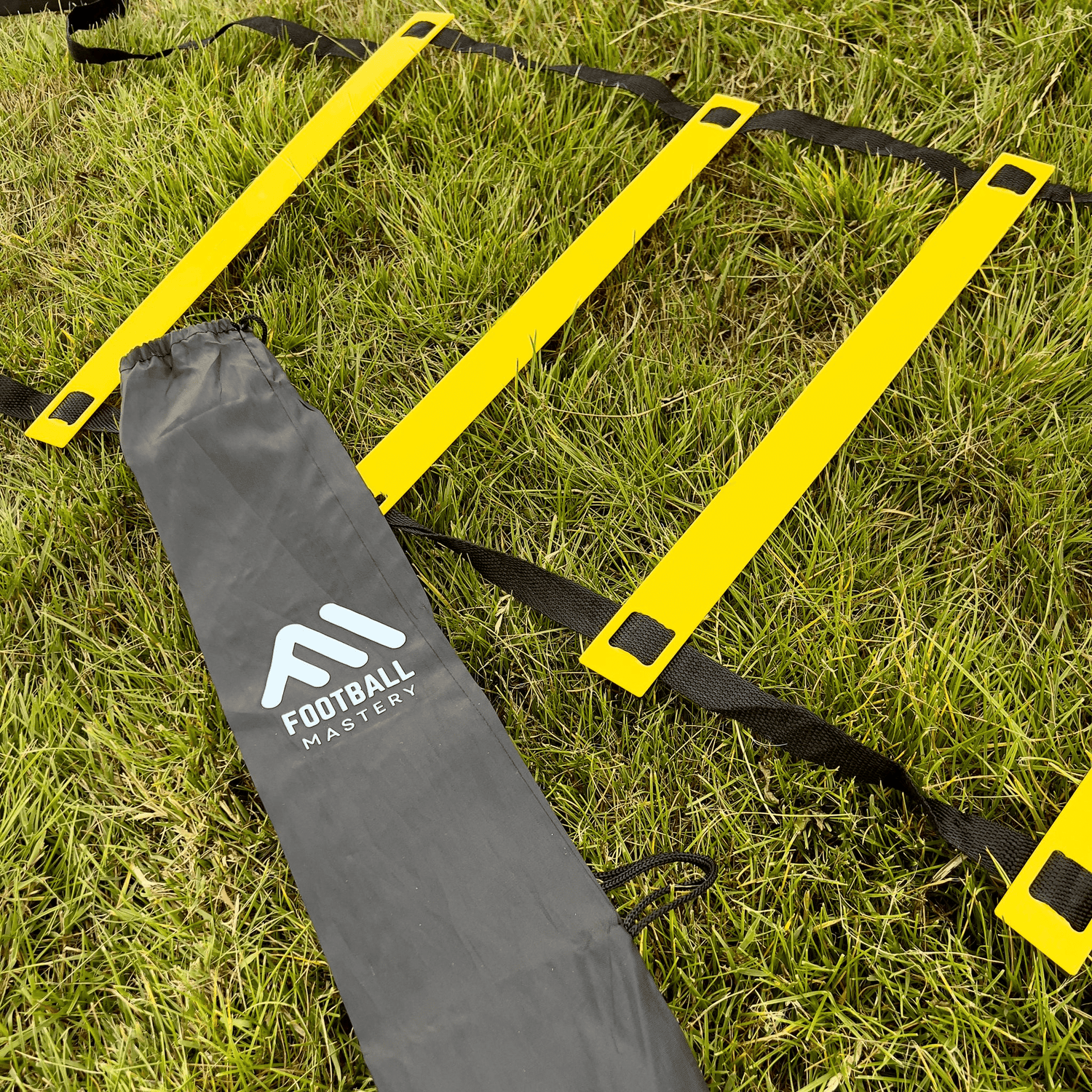
Agility Ladders: Improving Footwork and First Touch
An agility ladder is one of the most effective pieces of football coaching equipment for developing quick feet.
When paired with a soccer rebound board, it creates drills that challenge both coordination and technical ability.
Example Drill: Ladder to Rebound Pass
- Start at the beginning of the agility ladder.
- Perform a quick footwork pattern through the ladder.
- Move immediately to the rebound wall trainer.
- Pass into the board.
- Control the returning ball and deliver a second pass.
This drill trains:
- First touch drills
- Ball control drills
- Reaction speed
- Footwork coordination
Because the player must transition quickly from movement to technical control, the ladder acts as a conditioning tool for match situations.
These drills are especially useful for youth football training, where players need to develop coordination alongside technical skills.
Speed Hurdles: Building Explosive Movement
Another valuable accessory is the speed hurdle. These small barriers are designed to improve explosive power and acceleration.
When used alongside a kickback rebounder, they create drills that simulate chasing loose balls or reacting to passes under pressure.
Example Drill: Hurdle Reaction Drill
- Perform quick jumps over three speed hurdles.
- Sprint towards the rebound passing wall.
- Play a firm pass into the board.
- React quickly to the return and control the ball.
This exercise develops:
- Reaction training drills
- Acceleration
- Balance
- Ball control under fatigue
Because the player is slightly fatigued before receiving the return pass, it replicates the demands of real match play.
This type of training is often used in grassroots football training sessions and academy environments.
Slalom Poles: Dribbling Before the Pass
Slalom poles are commonly used to develop dribbling skills, but they also integrate perfectly with rebound board training.
A soccer rebounder placed at the end of a slalom course encourages players to transition from dribbling into passing and control.
Example Drill: Slalom to One-Touch Pass
- Dribble through five slalom poles.
- Approach the passing wall trainer.
- Play a one-touch pass into the rebounder.
- Receive the ball and turn away from the board.
This drill helps develop:
- Ball mastery drills
- One-touch drills
- Wall passing drills
- Ball control in tight spaces
The combination of dribbling and passing encourages players to maintain close control before executing a precise pass.
Adding Tactical Realism with Football Mannequins
While cones and ladders improve movement patterns, football mannequins introduce something equally important: realism.
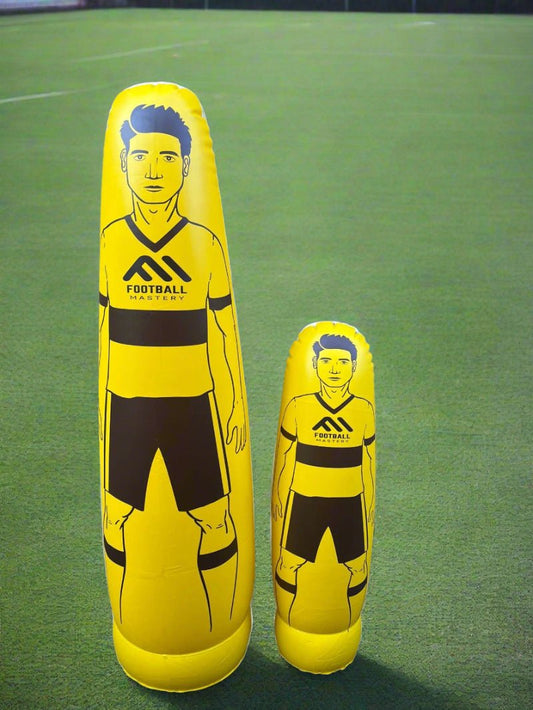
A rebound board by itself does not simulate defenders. Mannequins allow players to visualise opposition players and practise passing around or through defensive shapes.
Inflatable mannequins are particularly useful because they are lightweight, portable, and easy to set up.
For example, the Air Mannequins X3 can be positioned in front of a football rebound wall to replicate defensive pressure.
Example Drill: Pass Around the Defender
- Position a mannequin two metres in front of the rebound board.
- Start to the side of the mannequin.
- Pass around the defender into the board.
- Move quickly to receive the return pass.
This drill helps players practise:
- Passing angles
- Decision making
- First touch under pressure
It also encourages players to think about the types of passes used in real matches — whether that is a firm ground pass or a lifted pass around the defender.
Essential Training Footballs
It may sound obvious, but the number of training footballs used in a session can significantly influence training quality.
If players have only one ball during rebound training, they constantly need to retrieve it. This disrupts the flow of drills and reduces repetition.
Instead, coaches and serious players often train with:
- 5–10 footballs
- A ball carrying sack
- A quick access training area
This allows for continuous repetition — one of the most important principles of skill development.
With multiple balls available, players can perform repeated football passing drills against a soccer rebound target without interruption.
The goal is simple:
More repetitions lead to faster technical improvement.
Stability Accessories for Outdoor Rebound Training
When training outdoors, especially in gardens or parks, stability becomes important.
A portable football rebound board for garden training must remain steady even when hit with powerful passes.
Common stabilising accessories include:
- Sandbags / stabilising weights
- Ground pegs or stakes
- Weighted bases
These additions help keep a heavy-duty rebound board firmly in place during intense training sessions.
This is particularly useful when using a steel frame rebounder or acrylic rebound board, which are designed to produce strong, consistent ball returns.
Transport and Storage Accessories
Players who train frequently often move equipment between locations.
For this reason, simple accessories such as storage bags can make training much easier.
Helpful items include:
- Carry bag for rebound boards
- Equipment bag for cones and ladders
- Ball pump for maintaining correct pressure
- Net clips for securing training nets
These accessories may seem small, but they help players stay organised and ready to train at any time.
A well-organised kit turns a casual training session into a professional-style practice environment.
Creating a Complete Home Training Station
A serious home training setup does not require a full football pitch. With the right equipment, a driveway or garden can become a powerful development space.
A complete training station might include:
- A rebound training aid
- Marker cones
- An agility ladder
- Speed hurdles
- Slalom poles
- Football mannequins
- Several training footballs
Together, these tools form a compact yet effective football practice equipment setup.
At the centre of it all remains the football rebound trainer — the tool that delivers constant, reliable ball returns for endless technical repetitions.
Why Rebound Training Works So Well for Solo Sessions
Many players struggle to practise technical skills without a teammate.
Structuring Effective Rebound Board Training Sessions
Having the right equipment is only part of the equation. To maximise improvement, players need structured sessions that combine technique, movement, and decision-making.
A football rebound board allows players to perform hundreds of repetitions in a single training session. When combined with accessories such as cones, ladders, mannequins, and hurdles, it becomes the centrepiece of a complete football practice equipment setup.
Below is an example of a simple yet highly effective session structure.
1. Warm-Up: Ball Mastery and Movement
Start with light technical work to prepare the body and improve ball familiarity.
Equipment used
- Marker cones
- Training footballs
- Rebound training board
Drill
- Place four cones in a square around the passing rebounder.
- Pass into the board.
- Receive the return pass and move to a different cone.
- Repeat continuously for two minutes.
This warm-up introduces:
- Ball mastery drills
- First touch drills
- Light movement around the board
2. Technical Phase: One-Touch Passing
Once players are warmed up, the next stage is focused technical work.
A soccer rebound board for ball control practice is perfect for developing quick passing combinations.
Equipment used
- Rebound wall trainer
- Marker cones
Drill
- Stand two to three metres from the board.
- Pass firmly into the football rebound trainer.
- Return the ball with a one-touch pass.
- Maintain rhythm for 30–60 seconds.
This improves:
- One-touch drills
- Passing speed
- Passing accuracy
Consistent repetition with a passing practice board strengthens muscle memory and sharpens technical control.
3. Movement Phase: Reaction and Footwork
Next, introduce movement before receiving the ball.
Equipment used
- Agility ladder
- Speed hurdles
- Rebound board
Drill
- Perform a quick ladder pattern.
- Sprint to the rebound passing wall.
- Pass into the board.
- React quickly to the return ball.
This stage develops:
- Reaction training drills
- Coordination
- Quick decision-making
Training in this way helps simulate real match situations where players must control the ball immediately after sprinting.
4. Tactical Phase: Passing Around Defenders
To replicate match conditions more realistically, mannequins can be added.
Position defenders in front of the board to simulate blocked passing lanes.
Equipment used
- Football mannequins
- Marker cones
- Rebound training aid
Players can practise:
- Passing around a defender
- Quick movement after the pass
- Receiving the ball on the half-turn
Mannequins help recreate the visual pressure players experience during matches.
Training Ideas for Different Player Positions
A rebound training board for youth football can benefit players in every position on the pitch.
Different drills can be tailored to the demands of each role.
Midfielders
Midfielders rely heavily on fast ball circulation and awareness.
Recommended drills:
- One-touch passing drills
- Wall passing drills
- Reaction training board exercises
The aim is to improve decision-making speed when receiving passes in tight spaces.
Forwards
Forwards benefit from rebounders by practising:
- Volley training drills
- Shooting after rebound passes
- Quick first-touch finishes
A soccer rebound target can simulate rebounds from defenders or goalkeepers.
Defenders
Defenders can use rebound boards to practise:
- Clearances
- Controlled first touches
- Long passing
Using a dual-angle rebounder helps simulate both ground passes and aerial balls.
Goalkeepers
Rebound boards are also useful for goalkeepers.
They can perform:
- Goalkeeper reflex drills
- Reaction saves
- Quick distribution passes
A fast-return football reaction board can create unpredictable rebounds that challenge reflexes and coordination.
The Value of Consistent Solo Training
One of the greatest advantages of rebound boards is their usefulness for solo football training.
Players no longer need a partner to practise passing or first touch. The board acts as a reliable training partner that never tires.
With regular use, players can dramatically increase the number of touches they get on the ball.
For example, a 20-minute session with a football rebound wall can produce hundreds of passes and receptions.
That level of repetition is crucial for long-term skill development.
Choosing the Right Rebound Board Setup
When selecting equipment, players should look for a portable football rebound board for garden training that is durable, stable, and capable of producing consistent rebounds.
Features worth considering include:
- Adjustable rebound angle
- Durable materials
- Compact storage
- Weather resistance
A well-designed football rebound block should allow players to practise multiple techniques without constantly repositioning the board.
For players who want to build a complete home training setup, starting with a reliable rebound board is essential.
The Football Mastery Rebound Board Collection provides a range of rebound training solutions designed for skill development, durability, and convenience.
Final Thoughts
A rebound board is far more than a simple training surface.
When paired with the right accessories — cones, agility ladders, hurdles, mannequins, and training balls — it becomes a complete football skill trainer board capable of developing technical ability, reaction speed, and match awareness.
The key benefits include:
- Endless repetitions for skill development
- Structured football passing drills and ball control drills
- Effective home football training
- Versatile drills for every position
By building a training station around a soccer rebounder, players can recreate many of the situations they encounter during real matches.
With consistent practice, these tools help transform ordinary training sessions into focused, high-quality skill development environments.
Frequently Asked Questions About Accessories for Football Rebound Boards
1. What accessories improve passing accuracy when using a football rebound board?
To improve passing accuracy, players should combine a football rebound board with training accessories that guide positioning and movement.
The most effective accessories include:
- Marker cones to create passing gates and targets
- Football mannequins to simulate defenders
- Training footballs for continuous repetition
These accessories allow players to practise structured football passing drills and develop better passing angles when using a passing rebounder.
2. How can I make rebound board training more realistic?
To make sessions feel closer to match situations, players should introduce equipment that adds movement and decision-making.
Useful accessories include:
- Slalom poles for dribbling before passing
- Agility ladders for footwork before receiving the ball
- Football mannequins to simulate defensive pressure
Combining these with a rebound wall trainer helps players practise receiving the ball while moving and scanning the pitch.
3. Do I need stabilising equipment for a rebound board?
In many cases, yes — especially if you are training outdoors.
Accessories such as:
- Sandbags or stabilising weights
- Ground pegs or stakes
help keep a heavy-duty rebound board stable during powerful passes.
This is particularly useful for portable rebound boards used on grass, artificial turf, or uneven ground.
4. Can rebound boards be used indoors?
Yes, many rebound boards work well indoors, especially compact designs used as an indoor training rebounder.
When training indoors, players often use:
- A foldable rebound board
- Marker cones for positioning
- Soft training footballs
Indoor sessions are ideal for first touch drills, ball control drills, and short one-touch passing drills.
5. How many footballs should I use during rebound training?
Using multiple footballs significantly improves training efficiency.
Ideally, players should train with 5–10 balls stored in a ball carrying sack or equipment bag. This prevents constant interruptions to retrieve the ball and allows for continuous wall passing drills using the soccer rebound board.
More repetitions generally lead to faster skill development.
6. What accessories help improve reaction speed with a rebounder?
Reaction training can be enhanced by introducing equipment that forces players to react quickly before receiving the ball.
Some effective accessories include:
- Speed hurdles
- Agility ladders
- Marker cones
These tools create movement before the ball returns from the football reaction board, improving both physical and technical reaction speed.
7. Are football mannequins useful when training with rebound boards?
Yes. Football mannequins are extremely useful for creating realistic training scenarios.
They allow players to practise:
- Passing around defenders
- Receiving the ball under pressure
- Creating passing angles
When placed in front of a rebound passing wall, mannequins simulate opposition players and add tactical awareness to training drills.
8. What is the best training setup for solo football practice?
A strong solo football training setup usually includes:
- A football rebound trainer
- Marker cones
- An agility ladder
- Several training footballs
- Slalom poles or mannequins
This setup allows players to practise ball mastery drills, reaction training drills, and passing drills without needing a training partner.
9. Are rebound boards suitable for youth players?
Yes. A rebound training board for youth football is one of the most effective tools for developing technical skills at a young age.
Young players benefit from practising:
- First touch control
- Passing accuracy
- Ball control under pressure
Accessories like cones and ladders make drills more engaging and structured for youth development sessions.
10. What features should I look for in a quality rebound board?
When choosing a soccer rebounder, several features improve training versatility:
- Adjustable rebound angle for different drills
- Durable materials such as reinforced plastic or steel frames
- Strong and consistent ball return
- A stable base for outdoor training
Many players prefer a dual-angle rebounder or multi-angle rebounder, as these designs allow for both ground passes and aerial returns during training.
A well-designed rebound board acts as a long-term football training aid, supporting everything from first touch practice to advanced reaction drills football coaches use at higher levels.