

Portable Agility Training Kits for Football Coaches Top Options
Share
Portable agility training kits have become essential football coaching equipment for coaches working with youth players, grassroots clubs, academies and senior teams alike. The best portable agility training kit combines versatility, durability and ease of transport, allowing coaches to create engaging football training sessions almost anywhere.
A well-designed speed and agility training kit typically includes agility ladders, agility cones, marker discs, speed hurdles and other football training aids that support acceleration, quick feet training, coordination training and change of direction training. These tools help improve movement efficiency, reaction speed, balance, body control and overall sports performance while making football practice sessions more dynamic and enjoyable.
Whether you're running a grassroots football coaching programme, preparing players for match-speed training, or organising football academy training, investing in quality football agility training equipment can transform the effectiveness of every session.
Why Portable Agility Training Kits Have Become Essential for Modern Football Coaches
Football has changed dramatically over the past decade.
Players are faster. The game is quicker. Space closes down in an instant.
As a result, coaches can no longer rely solely on traditional technical drills to improve performance. Modern player development requires a combination of technical training, tactical training and athletic development.
That's where portable football training kits come into their own.
Rather than transporting large amounts of football practice equipment, coaches can carry an entire agility training set in a single carry bag and set up challenging drills within minutes. Whether you're training on a full-sized pitch, a school field or a compact training area, portable coaching equipment provides flexibility without sacrificing quality.
The most effective football training sessions often combine technical ball work with speed, agility and movement training to replicate real match situations.
For coaches working with multiple age groups, this versatility becomes invaluable.
A single portable sports training kit can be adapted for:
- Football warm-up drills
- Speed drills for football
- Football conditioning drills
- Coordination training
- Reaction training
- Small-sided games
- Football fitness drills
- Football development programmes
The result is greater engagement, better athletic performance training and improved agility performance across the squad.
What Makes a Great Portable Agility Training Kit?
Not all football coaching aids are created equal.
The best portable agility training kits strike a balance between portability, durability and training effectiveness.
When evaluating football speed training equipment, coaches should look for several key components.
1. Agility Ladders
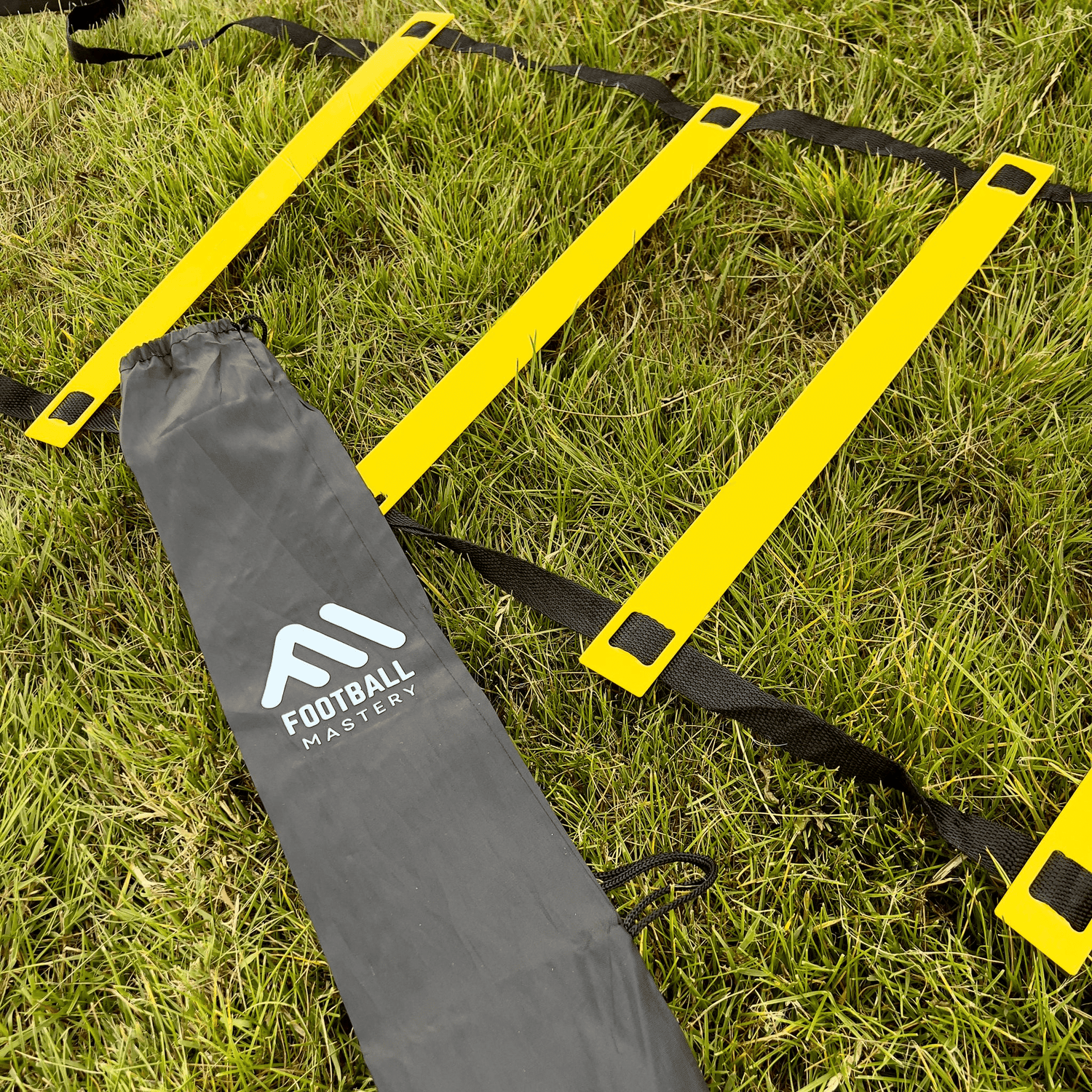
The agility ladder remains one of the most widely used pieces of football drill equipment available today.
Used correctly, it develops:
- Footwork training
- Coordination
- Quickness
- Balance
- Body control
- Neuromuscular training
A quality training ladder should lie flat on the surface, be adjustable and withstand repeated use throughout the season.
For coaches looking to build an effective football speed and coordination kit, the 3m Agility Ladder provides an excellent foundation for countless speed development and movement efficiency drills.
Popular ladder exercises include:
- One-foot runs
- Lateral shuffles
- In-and-out patterns
- Carioca movements
- Sprint exits
Combining these drills with football-specific movements helps bridge the gap between isolated athletic development and match performance.
2. Agility Cones and Marker Discs
Few pieces of football training equipment offer as much value as a set of agility cones.
Simple yet incredibly versatile, cones form the backbone of many football coaching drills.
Coaches regularly use them to create:
- Passing channels
- Dribbling circuits
- Sprint lanes
- Change of pace exercises
- Positional grids
- Reaction-based drills
Marker cones and marker discs are particularly useful because they allow coaches to alter session layouts quickly without interrupting the flow of training.
This flexibility becomes especially important during youth football coaching, where maintaining engagement is critical.
A well-planned football movement training kit should always include enough cones to accommodate multiple stations and group activities.
3. Speed Hurdles for Explosive Movement
When discussing football conditioning equipment, speed hurdles deserve special attention.
These lightweight training tools help players improve:
- Acceleration
- Deceleration
- Explosive speed
- Lateral movement
- Multidirectional movement
- Functional movement
Unlike traditional sprint training, hurdle drills encourage players to generate force rapidly while maintaining balance and coordination.
Many coaches incorporate agility hurdles into football agility circuit equipment because they create measurable challenges that players enjoy competing against.
Common hurdle drills include:
- Two-foot jumps
- Single-leg hops
- Sprint-and-clear exercises
- Lateral hurdle runs
- Reactive hurdle sequences
These exercises are particularly effective during football pre-season training equipment programmes, where building athletic capacity is a primary objective.
Building an All-in-One Agility Kit for Football Coaching
The most successful coaches rarely rely on a single piece of equipment.
Instead, they create a complete system capable of addressing every aspect of player development.
An effective all-in-one agility kit often combines:
| Equipment | Primary Benefit |
|---|---|
| Agility ladder | Foot speed and coordination |
| Agility cones | Drill organisation |
| Speed hurdles | Explosive movement |
| Resistance bands | Strength and activation |
| Agility poles | Direction changes |
| Reaction ball | Reaction speed |
Many coaches prefer purchasing complete solutions rather than assembling equipment individually.
The collections available within the Football Mastery Bundles category can help simplify equipment selection while ensuring coaches have the football coach essentials needed for varied and effective sessions.
A comprehensive football training equipment bundle reduces setup time, improves organisation and creates more opportunities for progressive training throughout the season.
Advanced Equipment That Elevates Agility Training Sessions
Once the foundations are in place with agility ladders, cones and hurdles, coaches can begin introducing more advanced football training accessories that challenge players in increasingly realistic situations.
The objective is simple: move beyond predictable movement patterns and create training environments that mirror the demands of competitive football.
The most effective football agility training equipment encourages players to think, react and move simultaneously.
Agility Poles and Slalom Poles for Directional Control
Few training tools replicate in-game movement quite like agility poles.
Often overlooked in favour of ladders and hurdles, agility poles introduce a decision-making element that is difficult to replicate with static equipment alone.
They are particularly effective for developing:
- Change of direction training
- Body positioning
- Movement efficiency
- Footwork training
- Acceleration and deceleration
- Ball-carrying control
A typical setup may involve a slalom run through agility poles followed by a sprint, pass or shooting action.
This combination develops technical ability while reinforcing athletic movement patterns.
For football academy training environments, agility poles are frequently incorporated into position-specific drills. Wide players can practise explosive directional changes, while defenders can work on recovery runs and body orientation.
Example Agility Pole Circuit
- Slalom through poles
- Accelerate into open space
- Receive a pass
- Complete a technical action
- Recover to starting position
The beauty of this approach lies in its transferability to match situations.
Players aren't simply running around equipment; they're learning to move more efficiently within football-specific scenarios.
Resistance Bands and Resistance Parachutes
Modern football conditioning drills increasingly incorporate resisted movement training.
Resistance bands are among the most versatile additions to any portable football training kit because they support both activation work and strength development.
Benefits include:
- Improved acceleration
- Enhanced balance
- Better body control
- Increased lower-body strength
- Injury prevention support
- Greater movement quality
Before training sessions, coaches often use resistance bands during football warm-up drills to activate key muscle groups.
This helps prepare players for high-intensity movement while reducing the risk of muscular issues during training.
Resistance parachutes take things one step further.
By creating drag during sprinting exercises, they encourage athletes to generate greater force during acceleration training.
For players seeking explosive speed improvements, resisted sprint work can become a valuable addition to a structured football development programme.
Speed isn't just about running faster. It's about producing force efficiently, maintaining technique and reacting quickly under pressure.
Reaction Balls and Reaction Training Equipment
Football rarely follows a predictable pattern.
A deflection, loose ball or unexpected bounce can completely change a phase of play.
That's why reaction training has become a major focus within modern coaching environments.
Reaction balls introduce unpredictability into drills by bouncing in irregular directions.
Coaches use them to develop:
- Reaction speed
- Hand-eye coordination
- Awareness
- Decision-making
- Quickness
- Athletic development
While commonly associated with goalkeeper training, reaction balls can benefit outfield players just as effectively.
For example, a coach may throw a reaction ball into a designated area and require players to react, recover possession and complete a pass within seconds.
These seemingly simple exercises encourage rapid information processing while maintaining physical intensity.
When included within a broader agility workout equipment setup, reaction tools help bridge the gap between physical preparation and match realism.
Creating Complete Football Agility Circuits
One of the biggest advantages of portable coaching equipment is the ability to create multiple training stations.
Rather than placing players in long queues, coaches can keep everyone active through circuit-based training.
A well-designed football agility circuit equipment setup might include four stations:
Station 1: Coordination Ladder
Focus:
- Quick feet training
- Coordination training
- Balance
Station 2: Speed Hurdles
Focus:
- Explosive speed
- Power production
- Athletic performance training
Station 3: Agility Poles
Focus:
- Change of pace
- Direction changes
- Movement training
Station 4: Reaction Ball Challenge
Focus:
- Reaction speed
- Awareness
- Decision-making
Players rotate every 60–90 seconds, creating a high-energy environment that maintains concentration and effort levels throughout the session.
This format works exceptionally well for:
- Grassroots football coaching
- Youth football coaching
- Football camps
- Academy development sessions
- Team conditioning work
The portability of modern football coach equipment means these circuits can be established almost anywhere within minutes.
Why Portable Equipment Matters for Grassroots Coaches
Elite clubs often have dedicated facilities and large equipment budgets.
Most grassroots clubs do not.
For volunteer coaches and community teams, practicality matters.
Equipment must be:
- Easy to transport
- Quick to set up
- Durable enough for regular use
- Suitable for multiple age groups
- Adaptable to different training objectives
This is why compact football training equipment continues to grow in popularity.
A travel-friendly coaching kit allows coaches to arrive at training with everything required for an engaging session contained within a single bag.
For those working with younger age groups, the range of <a href="https://footballmastery.co.uk/collections/kids-football-coaching-equipment">Kids Football Coaching Equipment</a> offers solutions specifically designed to support youth player development while keeping sessions enjoyable and accessible.
The ability to deliver high-quality training without excessive setup time allows coaches to focus on what truly matters: helping players improve.
Choosing Equipment for Different Age Groups
Not every speed and agility equipment setup should look the same.
The needs of a seven-year-old player differ significantly from those of a sixteen-year-old academy prospect.
Under 8s to Under 11s
Priorities include:
- Coordination
- Balance
- Fundamental movement skills
- Fun and engagement
Recommended equipment:
- Agility ladder
- Marker cones
- Reaction ball
- Lightweight hurdles
Under 12s to Under 16s
Focus shifts towards:
- Speed development
- Change of direction
- Technical execution under pressure
- Athletic development
Recommended equipment:
- Agility poles
- Speed hurdles
- Resistance bands
- Football speed and coordination kit
Older Youth and Senior Players
Training should emphasise:
- Match-speed training
- Explosive acceleration
- Football-specific conditioning
- High-intensity movement patterns
Recommended equipment:
- Resistance parachutes
- Advanced agility circuits
- Sprint training equipment
- Full football fitness equipment bundle
Selecting equipment appropriate to player maturity ensures consistent progression while reducing injury risk.
How to Choose the Best Portable Agility Training Kit
With countless products available, selecting the right portable agility training kit can feel overwhelming.
Many coaches make the mistake of focusing purely on price, only to discover that cheaper equipment often wears out quickly, breaks during sessions or lacks the versatility required for long-term use.
The best portable agility training kits deliver value through durability, flexibility and practical coaching applications.
Before purchasing, consider the following questions:
- How many players will use the equipment regularly?
- Will it be used for youth football coaching, senior football or both?
- Does it support multiple drill types?
- Is transportation straightforward?
- Can it be used throughout the entire season?
- Does it fit within existing football session planning?
A quality coach training kit should be capable of supporting everything from football warm-up drills to advanced football conditioning equipment programmes.
Features That Separate Great Equipment from Average Equipment
Not all football training equipment is designed with coaches in mind.
The most reliable products typically share several important characteristics.
Durability
Training equipment is subjected to constant use.
Cones are stepped on.
Ladders are dragged across surfaces.
Hurdles are knocked over repeatedly.
Quality materials ensure equipment remains effective throughout years of football practice sessions.
Portability
A true portable football training kit should be easy to transport between locations.
Look for equipment supplied with a carry bag that keeps everything organised and protected.
The ability to arrive at a training ground with a complete portable session setup saves valuable preparation time.
Versatility
The most valuable football coaching aids support a wide range of activities.
For example, agility cones can be used for:
- Passing drills
- Dribbling exercises
- Sprint training
- Positional work
- Small-sided games
The more uses a piece of equipment has, the greater its long-term value.
Safety
Equipment should remain stable during use and be suitable for the age group being coached.
This is especially important when introducing speed hurdles, resistance bands and football conditioning drills involving high-intensity movements.
Common Mistakes Coaches Make When Buying Agility Equipment
Even experienced coaches occasionally purchase equipment that ends up gathering dust in a storage cupboard.
Avoiding these common mistakes can save money and improve training quality.
Buying Individual Items Without a Plan
Many coaches purchase equipment one item at a time without considering how everything works together.
The result is often an inconsistent collection of tools that don't support structured player development.
Instead, think in terms of creating a complete football movement training kit that supports:
- Speed development
- Coordination training
- Reaction training
- Technical training
- Tactical training
When equipment complements each other, training sessions become far more effective.
Focusing Only on Speed
Speed is important.
However, football performance depends on far more than straight-line sprinting.
Players must also demonstrate:
- Coordination
- Balance
- Body control
- Decision-making
- Reaction speed
- Multidirectional movement
The best football agility training equipment develops all of these qualities simultaneously.
Ignoring Long-Term Player Development
Some coaches build sessions around novelty rather than progression.
While variety is useful, every piece of football training equipment should support a clear developmental objective.
Ask yourself:
How does this equipment help players perform better in matches?
If there isn't a clear answer, it may not deserve a place within your coaching setup.
Sample Portable Agility Session for Football Coaches
To illustrate how these tools work together, here's an example 45-minute session using a portable football drills equipment setup.
Warm-Up (10 Minutes)
Equipment:
- Marker cones
- Coordination ladder
Objectives:
- Raise body temperature
- Improve coordination
- Prepare movement patterns
Activities:
- Ladder footwork patterns
- Dynamic mobility exercises
- Short acceleration runs
Technical Movement Block (10 Minutes)
Equipment:
- Agility poles
- Footballs
- Marker discs
Objectives:
- Improve ball control while changing direction
- Develop movement efficiency
Activities:
- Slalom dribbling
- Directional turns
- Progressive speed increases
Athletic Development Block (15 Minutes)
Equipment:
- Speed hurdles
- Resistance bands
- Agility cones
Objectives:
- Build explosive speed
- Improve acceleration
- Enhance agility performance
Activities:
- Hurdle jumps
- Resisted sprint starts
- Cone reaction races
Competitive Game (10 Minutes)
Equipment:
- Cones
- Mini goals
Objectives:
- Transfer skills into realistic football situations
- Encourage quick decision-making
Activities:
- Small-sided games
- Transition exercises
- High-tempo possession challenges
This type of structure ensures players develop both physically and technically within the same training session.
Why Coaches Are Moving Towards Complete Equipment Bundles
As coaching demands continue to evolve, many coaches are choosing complete football training equipment bundles rather than individual items.
The benefits are obvious:
- Better value
- Consistent quality
- Easier storage
- Faster setup
- Greater training variety
Whether coaching a school team, academy squad or grassroots club, a complete team training agility set allows coaches to adapt quickly to changing objectives throughout the season.
For coaches seeking trusted football coach essentials, investing in a carefully selected combination of ladders, cones, hurdles and reaction-based equipment creates a foundation that can support years of player development.
Final Thoughts
The most effective football coaches understand that athletic development and technical development should work hand in hand.
A well-chosen portable agility training kit provides far more than convenience. It creates opportunities for better movement training, faster decision-making, improved coordination and enhanced sports performance.
From agility ladders and agility cones to speed hurdles, agility poles, resistance bands and reaction training equipment, each component plays a role in helping players move more effectively on the pitch.
Whether you're delivering youth football agility equipment sessions, running football academy equipment programmes or supporting grassroots clubs, the right football coaching equipment can transform the quality of every session.
At its best, portable equipment removes barriers. It allows coaches to focus less on logistics and more on creating engaging, challenging and purposeful training environments that help players reach their potential.
For coaches looking to elevate their football training sessions, improve agility performance and build a complete football coach starter kit, investing in high-quality, coach-approved agility equipment remains one of the smartest decisions they can make.
Frequently Asked Questions About Portable Agility Training Kits for Football Coaches
1. How much space do I need to use a portable agility training kit effectively?
One of the biggest advantages of a portable agility training kit is that it requires very little space. Basic agility ladder and cone drills can be performed in areas as small as 10m x 10m, making them ideal for school playgrounds, community pitches and compact training zones. Larger agility circuits incorporating speed hurdles and agility poles may require additional space, but most football coaching equipment is designed to be adaptable to varying environments.
2. How long should agility training sessions last?
For most players, agility-focused training should last between 15 and 30 minutes within a broader football training session. Younger players often benefit from shorter, high-energy activities, while older players can handle longer periods of speed development, reaction training and football conditioning drills.
3. Can portable agility equipment be used indoors?
Yes. Most portable football training equipment can be used indoors on sports hall floors, gymnasiums or indoor training facilities. Marker cones, agility ladders, reaction balls and agility poles are particularly suitable for indoor use. Coaches should simply ensure the surface provides adequate grip and safety for movement-based exercises.
4. How often should football players perform agility training?
Agility training can be incorporated into football practice sessions two to three times per week. Consistent exposure helps improve coordination, quickness, reaction speed and movement efficiency without overloading players. During pre-season periods, coaches may increase the frequency to accelerate athletic development.
5. Are portable agility kits suitable for goalkeepers?
Absolutely. While many coaches associate agility equipment with outfield players, goalkeepers can benefit significantly from reaction training equipment, agility ladders, speed hurdles and marker cone drills. These tools help improve footwork, balance, coordination and explosive movement around the penalty area.
6. What is the lifespan of quality football agility training equipment?
The lifespan depends on usage and storage conditions, but high-quality football coaching aids can last several seasons when properly maintained. Equipment should be stored in a dry location, cleaned regularly and transported using a dedicated carry bag to maximise durability.
7. Can agility equipment improve injury resilience in football players?
While no equipment can completely prevent injuries, agility training supports better movement mechanics, balance, body control and neuromuscular training. These improvements can contribute to injury prevention by helping players move more efficiently and react more effectively during high-intensity football situations.
8. Is it better to buy individual items or a complete agility training set?
For most coaches, a complete agility training set offers better overall value. Purchasing a football training equipment bundle ensures all components work together and provides greater flexibility for football coaching drills. It also eliminates the need to source multiple pieces of equipment separately.
9. What should a football coach keep in a basic portable coaching kit?
A practical football coach starter kit should include:
- Agility ladder
- Marker cones
- Marker discs
- Speed hurdles
- Pump and footballs
- Bibs
- Carry bag
- Stopwatch or timing device
This combination allows coaches to deliver a wide range of football fitness drills, technical exercises and speed training activities.
10. What are the biggest benefits of portable agility training kits compared to traditional training equipment?
Portable agility kits offer several advantages over larger, less mobile equipment:
- Faster session setup
- Easier transportation
- Greater training variety
- Improved adaptability
- Reduced storage requirements
- Cost-effective player development
For modern football coaches, portable agility equipment provides a practical way to deliver high-quality speed, coordination and movement training regardless of location, age group or squad size.